
Strawberry and raspberry resistance
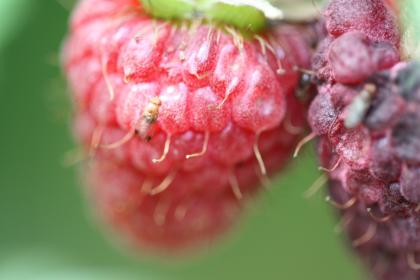
Another approach to control that hasn’t been fully explored is fruit variety resistance to spotted wing drosophila (SWD). Ripening soft and stone fruits are highly attractive to adult SWD, with the female making an incision in the skin of the fruit and laying eggs under the surface. The resulting larvae feed on the flesh of the fruit, leading to fruit collapse and an unmarketable product. If any accessions (varieties, selections or species) of soft fruits are found to have berries that are less attractive to SWD or that inhibit egg laying or larval emergence, we could then investigate the fruit traits that are associated with this and utilise such traits in fruit breeding programmes.
In a Growing Kent & Medway funded project, in partnership with Asplins PO and WB Chambers, Niab screened many accessions of strawberry and raspberry to identify if any show tolerance to SWD.
Across the life of the project a wide range of strawberry and raspberry genotypes were chosen based on their origin and pedigree. The material tested was diverse and included differing traits like skin colour, skin firmness, flesh firmness, size, and sugar levels (Brix). The aim was to identify any correlations between fruit traits and emergence of adult SWD from the fruit.
A total of 76 accessions of strawberry and 36 accessions of raspberry were planted in an SWD proofed tunnel on a commercial soft fruit farm, by kind permission of WB Chambers, who maintained the plants throughout the project. Fruit was picked throughout the season, brought back to Niab laboratories where fruit traits were assessed and the fruit exposed in containers to adult female SWD. The number of eggs laid in each variety was recorded and the adult females then removed. Following 14 days, the number of emerging adults was counted from each of the original berries. In addition, strawberries were tested for attraction to SWD in a choice test in the laboratory, pitching more versus less susceptible varieties against each other.
In the first year results for strawberry and raspberry were very promising, as there was found to be statistically significant variation in the numbers of adults emerging from different varieties. The genotypes used were grouped together based on the level of emergence. For those genotypes where a lack of emergence was found, some fruit quality traits were correlated. In particular, the levels of Brix (for strawberry and raspberry) and the skin colour (strawberry) appeared to influence the level of SWD emergence from fruit.
The work was repeated in the second year for both strawberry and raspberry, but this time the order of susceptibility changed between accessions. Brix was a less reliable predictor of fruit vulnerability and colour also failed to give an indication of SWD egg laying.
In the laboratory choice tests, adult female SWD were also not influenced by which fruits they lay their eggs in – it seems they just lay on the first fruit they come across.
This project highlights that growers should not rely on varietal planting to control SWD as this can vary between years and SWD females’ drive to lay eggs is difficult to deter. It should be noted that SWD can lay eggs in unripe fruit rendering soft fruits particularity vulnerable to SWD damage.
Bait sprays
Push-pull control strategies
Reducing overwintering populations
Sterile Insect Technique
Further studies
Contact
Niab
Park Farm Campus
Villa Road
Histon
Cambridge
CB24 9AT, UK
Tel: +44(0)1223 342200
Email: [email protected]


Niab Agronomy
Membership

© NIAB 2026