
Push-pull control strategy
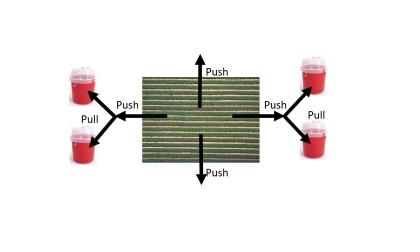
Research has been done by Niab to combine the use of repellents and attractants, so that the pest could be pushed away from the crop using a repellent and attracted into a trap containing a fatal component.
Research carried out by PhD student Christina Conroy as part of the CTP for Fruit Crop Research studentship scheme, identified a chemical repellent that causes a reduction in egg laying in strawberries up to 6 metres away from the sachet containing the repellent. Other research has demonstrated how precision monitoring traps can be used to reduce overwintering populations in habitats such as woodland adjacent to fruit crops in the winter. Further work was required to combine both approaches.
In an Innovate UK funded project, Niab worked with industry partners Russell IPM, Rumwood Green Farm, University of Greenwich (NRI) and WB Chambers to combine these findings into a push-pull approach to improve management and control of the pest.
They set out to test the repellent compound in raspberry crops then carried out further trials in a commercial strawberry crop, combining the repellent inside the crop (to push the pest out of the crop), with a lure around the perimeter of the crop (to pull the pest away from the crop). Further work was done to optimise existing repellents and attractants for use by commercial growers.
Disappointingly, in testing the repellent compound in 12 m long mini-tunnels planted with raspberry, no clear reduction in SWD egg laying was recorded, despite increasing the dose of the compound.
In the push-pull experiment in a commercial strawberry crop over two years, no reduction in egg laying was recorded. Further testing was done using double the number of repellent dispensers, sampling fruit close to dispensers, deploying dispensers in the crop from planting onwards, and including Russell IPM’s commercially available MagiPal. The MagiPal product, demonstrated to attract natural enemies into crops, was also shown by Christina Conroy in the laboratory to be repellent to spotted wing drosophila (SWD).
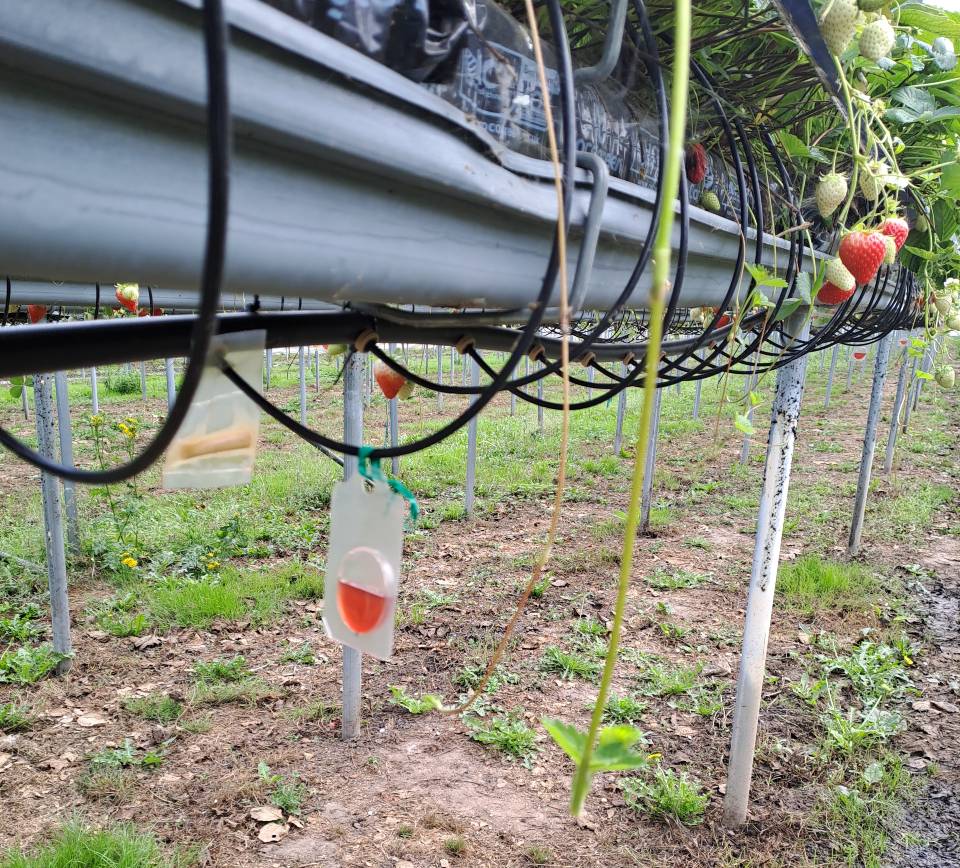
Both MagiPal and the prototype repellent in a commercial crop
However, despite making these adjustments, no further egg reductions were observed. These results were disappointing and demonstrate how difficult it is to control SWD in a commercial setting even though laboratory and small field tests can initially look promising.
It is likely that other factors in commercial crops prevent the repellent working. For example the size of the fields and how the fly perceives the cropping area through vision, detection of fruit and yeast volatiles, and climatic conditions.
In seeking to optimise attractants (the pull component), the Niab team had an idea of a component that might be blended into the liquid products developed by Russell IPM to improve attraction. Liquid baits were compared to standard commercially available liquid baits in field trials.
Encouragingly, the newly developed Russell IPM blend was as attractive as the standard Gasser bait which is no longer available. This was an encouraging result, showing that a UK produced bait can be substituted for a bait produced overseas, thereby reducing transport costs and carbon footprint.
Niab is extremely grateful to the commercial growers who hosted this research, without whom the work would not have been possible.
Previous work by Niab has shown that employing the practice of winter precision monitoring year after year has helped to reduce local numbers of SWD on farms over time and particularly in crops in the spring. Traps should be positioned in hedgerows and woodland, especially in areas of bramble, elder and ivy.
Bait sprays
Reducing overwintering populations
Sterile Insect Technique
Strawberry and raspberry resistance
Further studies
Further reading
Jones, R, Goddard, M.R, Eady, P.E, Hall, D.R, Bray, D.P, Farman, D.I. & Fountain, M.T. (2025). Differential attraction of summer and winter morphs of spotted wing Drosophila, Drosophila suzukii, to yeasts. Journal of Chemical Ecology, 51(1), pp.1-13. https://www.researchgate.net/publication/388709045_Differential_Attraction_of_Summer_and_Winter_Morphs_of_Spotted_Wing_Drosophila_Drosophila_suzukii_to_Yeasts
Conroy, C, Fountain, M.T, Whitfield, E.C, Hall, D.R, Farman, D. & Bray, D.P. (2024). Methyl N,N-dimethylanthranilate and ethyl propionate: repellents effective against spotted wing drosophila, Drosophila suzukii. Pest Management Science. https://scijournals.onlinelibrary.wiley.com/doi/10.1002/ps.8020
Jones, R, Eady, P.E, Goddard, M.R, Fountain, M.T. (2022). The Efficacy of Yeast Phagostimulant Baits in Attract-and-Kill Strategies Varies between Summer- and Winter-Morphs of Drosophila suzukii. Insects, 13, 995. https://www.mdpi.com/2075-4450/13/11/995
Jones, R, Fountain, M.T, Andreani, N.A, Günther, C.S. & Goddard, M.R. (2022). The relative abundances of yeasts attractive to Drosophila suzukii differ between fruit types and are greatest on raspberries. Scientific Reports 12, 10382. https://www.nature.com/articles/s41598-022-14275-x
Jones, R, Fountain, M.T, Günther, C, Eady, P. & Goddard, M. (2021). Separate and combined volatile profiles produced by Hanseniaspora uvarum and Metschnikowia pulcherrima yeasts are attractive to Drosophila suzukii in the laboratory and field. Scientific Reports 11, 1201. https://www.nature.com/articles/s41598-020-79691-3
Noble, R, Dobrovin-Pennington, A, Phillips, A, Cannon, M.F.L, Shaw, B. & Fountain, M.T. (2019). Improved insecticidal control of spotted wing drosophila (Drosophila suzukii) using yeast and fermented strawberry juice baits. Crop Protection, 125. https://www.sciencedirect.com/science/article/abs/pii/S0261219419302480?via%3Dihub
Contact
Niab
Park Farm Campus
Villa Road
Histon
Cambridge
CB24 9AT, UK
Tel: +44(0)1223 342200
Email: [email protected]


Niab Agronomy
Membership

© NIAB 2026