
Bait spray control
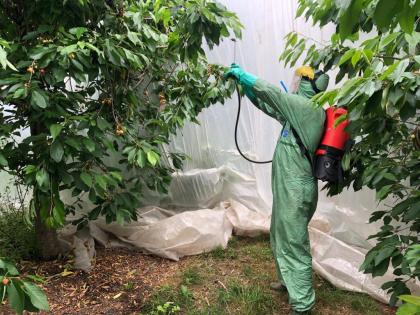
AHDB Project SF/TF 145a funded Niab to collaborate with Microbiotech to investigate a method of control using bait sprays.
The research has been very successful in strawberry, raspberry and cherry. A coded product containing sugars (now named ‘Probandz’) and a commercially available adjuvant Combi-Protec are both very attractive to spotted wing drosophila (SWD) adults. When added to reduced rates of Benevia on strawberry or Tracer and Exirel on raspberry and cherry, and sprayed to a reduced area of the crop canopy, they attracted SWD adults to feed on the sprayed leaves, allowing them to ingest the control chemical causing death.
When using most adjuvants, plant protection products must not exceed 50% of the normal recommended rate. Niab experimented with 50% of the recommended rate and lower, and when applied as a band of large droplets, achieved comparable control to full rate overall crop sprays.
This bait spray work has identified an effective alternative to full foliar applications of the full rate of product by applying a band spray to a reduced area of crop canopy. This offers the chance to reduce the risk of chemical residues, whilst also decreasing the total cost of control product and rate of application to a given area, bringing both economic and environmental benefits.
The coded product (named ‘Probandz’) is now registered by Russell IPM for use in the UK by commercial growers. Both Probandz and Combi-Protec are authorised for use in the UK as adjuvants (applied with 50% rate of product) but only in combination with products with standard ‘on-label’ or EAMU authorisations and not emergency authorisations. The manufacturers of Tracer, Exirel and Benevia have not yet funded their own work on bait sprays, so do not currently support this method of application.
Questions were raised by the industry over the efficacy of bait sprays compared to conventional application of plant protection products for SWD control as well as the Maximum Residue Levels that might result in fruit crops that have been treated in this way.
AHDB funded Niab to progress testing of bait sprays in a commercial raspberry crop, and compare efficacy to full rate, grower standard plant protection product (PPP) spray regimes. PPP residue levels were also quantified to determine if treatments are likely to exceed maximum levels. In addition, the scientists measured the impact of bait sprays on non-target organisms in the crop, e.g., numbers of pollinators visiting flowers and natural enemies in the crop canopy.
The entomology team at Niab noted the number of visits from various non-target insects such as pollinators, beneficial insects and predators. When comparing full rate overall sprays with bait sprays, there were no significant differences in bumblebee or honeybee numbers visiting raspberry flowers or leaves, suggesting that bait sprays had no effect in attracting beneficials to these plots.
They also conducted tap sampling and assessed numbers of insects found. Orius, parasitic wasps and spiders were recorded but there were no significant differences in numbers between different treatments. Similarly, there were no significant differences in numbers of pest species or ants, although there were higher numbers of some fly species in the Probandz plus 4% plant protection product treatment. Residues of spinosad and cyantraniliprole in fruit were below the MRLs and on most occasions lower in the bait sprayed fruit compared to the fruit from full rate applications.
An additional study was funded by The Worshipful Company of Fruiterers allowing Niab to investigate the impact that such bait spray treatments may have on six non-target insect species including Orius (commonly used in soft fruit production for thrips control), ladybirds (voracious predators of aphid pests), lacewings (common natural enemy of aphids), earwigs (a generalist predator of a range of pests found in orchard crops), hoverflies (voracious predator of aphids) and the common fruit fly, Drosophila melanogaster (non-target, closely related to SWD and vital in the ecosystem to aid in organic matter degradation).
Using a series of laboratory bioassays which exposed groups of beneficial and non-target insects to PPPs with or without bait, compared to bait alone and a water control, the potential impact of PPP:bait mixtures on non-target insects was determined.
The results of the toxicity studies separated the insects into three broad groups; 1) adult hoverflies, adult earwigs, Orius, 2) adult Drosophila melanogaster, and 3) lacewing and ladybird larvae.
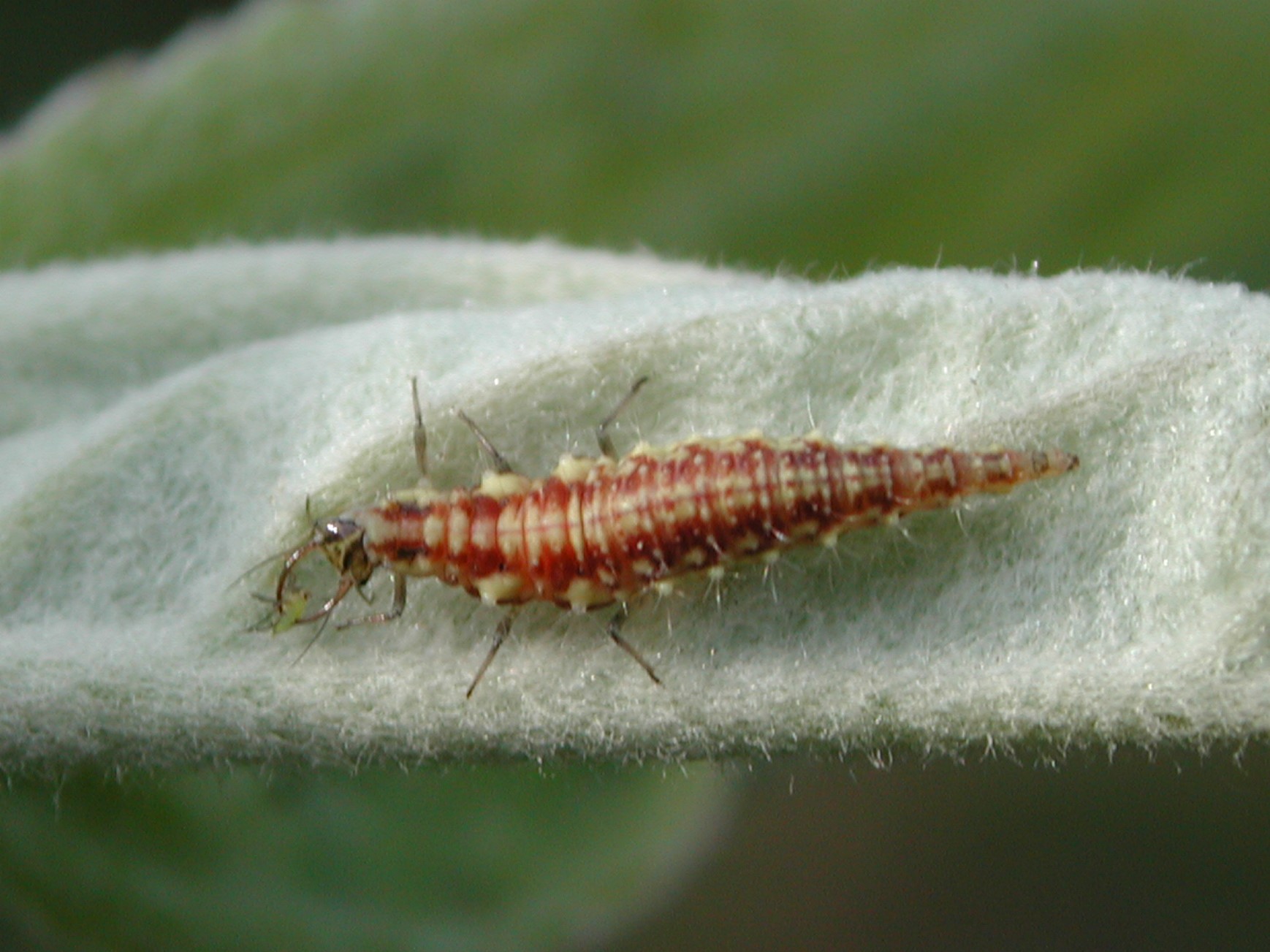
Niab investigated the impact of bait sprays on lacewing larvae
In the first group, bait + spinosad or spinosad alone both had a detrimental impact on the insect’s life expectancy although the speed of kill differed between insect groups.
For the second group, the bait + spinosad treatment was faster acting than spinosad applied without bait, presumably because the species, closely related to SWD, was attracted to, and fed on the insecticide, more readily.
No detrimental impact of the treatments was observed on the third group.
Spinosad with bait appears to be no more toxic to beneficial insects than if applied in the same size droplets without bait, except for the non-target insect, D. melanogaster where the speed of kill was faster when a bait was added. Baits alone had no detrimental effect on any of the insects.
In conclusion, baits added to PPPs and applied indirectly as large droplets are no more toxic to beneficial insects than full foliar sprays. In principle exposure to PPPs should be reduced because less product is applied to the crop, and usually away from the fruit. This is likely to have benefits for biocontrol programmes for SWD and other pests.
Push-pull control strategies
Reducing overwintering populations
Sterile Insect Technique
Strawberry and raspberry resistance
Further studies
Further reading
Fountain, M.T, Walker, A, Deakin, G, Dobrovin‐Pennington, A, Noble, R. & Shaw, B. (2025). Bait Sprays Combined With Insecticides Targeted at Drosophila suzukii Have Negligible Impacts on Non‐Target Insects Compared to Full Foliar Spray Applications. Journal of Applied Entomology.
https://onlinelibrary.wiley.com/doi/10.1111/jen.13452?af=R
Jones, R, Goddard, M.R, Eady, P.E, Hall, D.R, Bray, D.P, Farman, D.I. & Fountain, M.T. (2025). Differential attraction of summer and winter morphs of spotted wing Drosophila, Drosophila suzukii, to yeasts. Journal of Chemical Ecology, 51(1), pp.1-13. https://www.researchgate.net/publication/388709045_Differential_Attraction_of_Summer_and_Winter_Morphs_of_Spotted_Wing_Drosophila_Drosophila_suzukii_to_Yeasts
Jones, R, Eady, P.E, Goddard, M.R, Fountain, M.T. (2022). The Efficacy of Yeast Phagostimulant Baits in Attract-and-Kill Strategies Varies between Summer- and Winter-Morphs of Drosophila suzukii. Insects, 13, 995. https://www.mdpi.com/2075-4450/13/11/995
Jones, R, Fountain, M.T, Andreani, N.A, Günther, C.S. & Goddard, M.R. (2022). The relative abundances of yeasts attractive to Drosophila suzukii differ between fruit types and are greatest on raspberries. Scientific Reports 12, 10382. https://www.nature.com/articles/s41598-022-14275-x
Jones, R, Fountain, M.T, Günther, C, Eady, P. & Goddard, M. (2021). Separate and combined volatile profiles produced by Hanseniaspora uvarum and Metschnikowia pulcherrima yeasts are attractive to Drosophila suzukii in the laboratory and field. Scientific Reports 11, 1201. https://www.nature.com/articles/s41598-020-79691-3
Noble, R, Shaw, B, Walker, A, Whitfield, E.C, Deakin, G, Harris, A, Dobrovin-Pennington, A. & Fountain, M.T. (2023). Control of spotted wing drosophila (Drosophila suzukii) in sweet cherry and raspberry using bait sprays. J Pest Sci. https://link.springer.com/article/10.1007/s10340-022-01566-5
Noble, R, Walker, A, Whitfield, E.C, Harris. A, Dobrovin-Pennington. A & Fountain M.T. (2021). Minimising insecticides for control of spotted wing drosophila (Drosophila suzukii) in soft fruit using bait sprays. Journal of Applied Entomology. https://onlinelibrary.wiley.com/doi/10.1111/jen.12917
Noble, R, Dobrovin-Pennington, A, Phillips, A, Cannon, M.F.L, Shaw, B. & Fountain, M.T. (2019). Improved insecticidal control of spotted wing drosophila (Drosophila suzukii) using yeast and fermented strawberry juice baits. Crop Protection, 125. https://www.sciencedirect.com/science/article/abs/pii/S0261219419302480?via%3Dihub
Contact
Niab
Park Farm Campus
Villa Road
Histon
Cambridge
CB24 9AT, UK
Tel: +44(0)1223 342200
Email: [email protected]


Niab Agronomy
Membership

© NIAB 2026