
Further PhD and post-doctoral studies
Several other projects in recent years funded by AHDB, Berry Gardens Growers Ltd, The Worshipful Company of Fruiterers and Innovate UK have experimented with pathogenic viruses, parasitoids, entomopathogenic fungi and biotremology as control options but with less success.
Research into exclusion of SWD using narrow mesh netting
Further work in collaboration with a Waitrose CTP PhD studentship supervised by Niab and the University of Reading looked at the effects of the use of narrow mesh netting, which is employed by some growers to exclude adult spotted wing drosophila (SWD) from their crops.
There is concern that this leads to increased humidity and reduced light levels which may be having an adverse effect on the growth, yield and susceptibility to pests and diseases. Mesh may also prevent natural biological controls (e.g. hoverflies) from entering the crop.
In this study which assessed the effect of narrow mesh netting on a commercial raspberry crop, there were significantly fewer SWD adults caught in traps inside meshed tunnels compared with the neighbouring edge traps, but not between mesh and control tunnels. However, many other studies have reported positive impacts of mesh on the abundance of SWD in mesh covered crops.
Following mesh installation on tunnels, this PhD study recorded fewer ants and parasitic wasps but higher numbers of spider compared to control tunnels. This reduction in parasitoid numbers is a concern as certain species are known to parasitise SWD larvae.
The incidence of sooty mould on the shoulders of raspberry fruits increased by 2% under the narrow mesh compared to unmeshed tunnels. Mesh tunnels experienced a higher number of instances of peak temperature (30-35oC) and humidity (91-100% RH) when compared to open control tunnels after the mesh was implemented, which may have resulted in the increased occurrence of sooty moulds.
Deterring oviposition by SWD
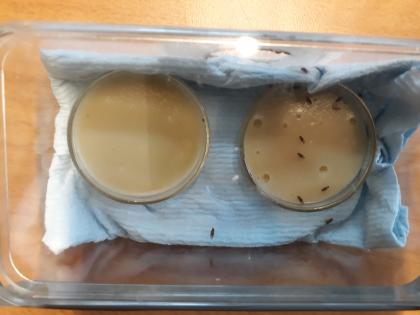
Work at Niab discovered that SWD does not like to lay eggs where the common fruit fly (Drosophila melanogaster) has laid eggs. It was thought that a signal was left by D. melanogaster which deterred SWD from laying eggs. A further BBSRC funded study at East Malling discovered that the larval stage of D. melanogaster deters female SWD from laying eggs.
Drosophila melanogaster cuticular hydrocarbons were examined as the signal source, but no evidence was found for their involvement. These results have improved our understanding of the interspecific interactions between SWD and other Drosophila species and could provide new innovative approaches to SWD management strategies.
Bait sprays
Push-pull control strategies
Reducing overwintering populations
Sterile Insect Technique
Strawberry and raspberry resistance
Further reading
Buck, N, Fountain, M.T, Potts, S.G, Bishop, J. & Garratt, M.P.D. (2023). The effects of non-crop habitat on Spotted Wing Drosophila (Drosophila suzukii) abundance in fruit systems: a meta-analysis. Agricultural and Forest Entomology, 25 (1), 66-76. https://resjournals.onlinelibrary.wiley.com/doi/full/10.1111/afe.12531
Buck, N, Fountain, M.T, Potts, S.G. & Garratt, M,P,D. (2024). Insect excluding mesh enhances SWD (Drosophila suzukii) control in tunnelled raspberry with limited effects on natural enemy abundance Agriculture, Ecosystems and Environment 359, 108756. https://www.sciencedirect.com/science/article/pii/S0167880923004152?via%3Dihub
Fountain, M.T, Badiee, A, Hemer, S, Delgado, A, Mangan, M, Dowding, C, Davis, F. & Pearson, S. (2020). The use of light spectrum blocking films to reduce populations of Drosophila suzukii Matsumura in fruit crops. Scientific Reports, 10, 15358. https://www.nature.com/articles/s41598-020-72074-8
Fountain, M.T, Bennett, J, Cobo-Medina, M, Conde Ruiz, R, Deakin, G, Delgado, A, Harrison, R. & Harrison, N. (2018). Alimentary microbes of winter-form Drosophila suzukii. Insect Molecular Biology 27 (3), 383-392. https://resjournals.onlinelibrary.wiley.com/doi/10.1111/imb.12377
Shaw, B, Walker, A, Hemer, S, Cannon, M.F.L, Brown, B, Rogai, F.M. & Fountain, M.T. (2023). Preliminary evidence of Drosophila suzukii parasitism in Southeast England. Parasitol Res 122, 2585–2597. https://link.springer.com/article/10.1007/s00436-023-07957-6
Shaw, B, Fountain, M.T, Wijnen, H. (2019). Control of daily locomotor activity patterns in Drosophila suzukii by the circadian clock, light, temperature and social interactions. Journal of Biological Rhythms, 1-19. https://journals.sagepub.com/doi/10.1177/0748730419869085
Shaw, B, Brain, P, Wijnen, H. & Fountain, M.T. (2018). Reducing Drosophila suzukii emergence through inter-species competition. Pest Management Science 74 (6),1466-1471. https://scijournals.onlinelibrary.wiley.com/doi/10.1002/ps.4836
Shaw, B, Fountain, M.T. & Wijnen, H. (2018). Recording and reproducing the diurnal oviposition rhythms of wild populations of the soft- and stonefruit pest Drosophila suzukii. PLoS ONE 13 (10),1-20. https://journals.plos.org/plosone/article?id=10.1371/journal.pone.0199406
Tungadi, T.D, Powell, G, Shaw, B. & Fountain, M.T. (2023). Factors influencing oviposition behaviour of the invasive pest, Drosophila suzukii, derived from interactions with other Drosophila species: potential applications for control. Pest Management Science. https://scijournals.onlinelibrary.wiley.com/doi/10.1002/ps.7693
Tungadi, T.D, Shaw, B, Powell, G, Hall, D.R, Bray, D.P, Harte, S.J, Farman, D.I, Wijnen, H. & Fountain, M.T. (2022). Live Drosophila Melanogaster Larvae Deter Oviposition by Drosophila suzukii. Insects 13 No. 8, 688. https://www.mdpi.com/2075-4450/13/8/688
Contact
Niab
Park Farm Campus
Villa Road
Histon
Cambridge
CB24 9AT, UK
Tel: +44(0)1223 342200
Email: [email protected]


Niab Agronomy
Membership

© NIAB 2026