
Sterile insect technique
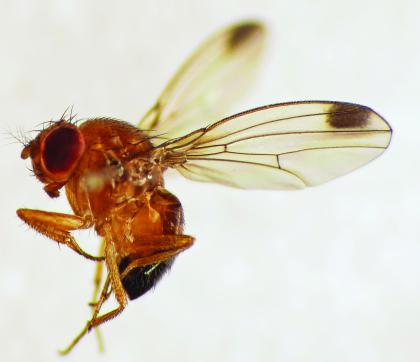
In an Innovate UK funded project, Niab collaborated with BigSis, a start-up company, and Berry Gardens Growers Ltd, to exploit a new approach called the Sterile Insect Technique (SIT).
Sterile males are produced and introduced regularly by BigSis staff, to the semi-natural areas surrounding crops and within the crops themselves. These sterile males compete with wild males to mate with wild female spotted wing drosophila (SWD), which subsequently fail to produce any offspring. Such an approach is sustainable, non-toxic as the sterile males can’t establish in the environment, and is species specific, so has no effect on beneficial insects or other fauna.
As native wild SWD are used to create the sterile males, there are no barriers to introducing the control system in the UK once the technique has been proven to be effective.
Early trials on strawberry showed very encouraging results with SWD levels remaining very low throughout the season compared to the SWD populations in adjacent crops with no SIT release which received plant protection products only. Further research assessed the SIT technique in the laboratory, in further field trials, and in ‘semi-field’ trials. The laboratory work tested, for example, how well the sterile males compete with wild female SWD and what ratios of sterile males to wild females are required for effective control.
The work demonstrated that small plot experiments are vulnerable to border effects, where wild males can migrate across adjacent fields, so all future commercial experiments should be done on a minimum field size of 7 ha.
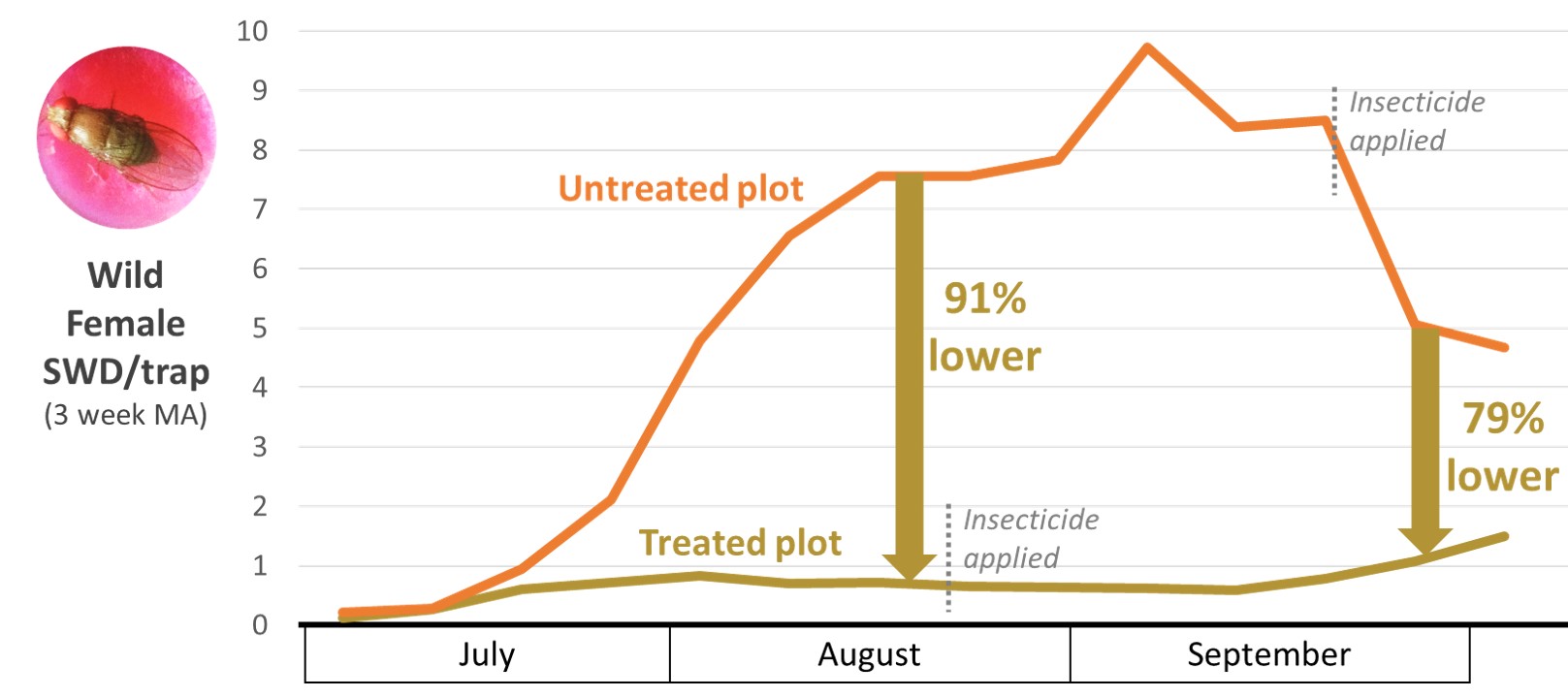
Trial showing how the SIT techniques maintains low populations of SWD compared to the use of crop protection sprays
Work on blackberry provided season-long suppression compared to an untreated control. However, different crops have different dynamics and this has implications for release rates and tactics to control wild populations. It was also found that if no or low releases are made for one to two weeks or more, wild populations increase rapidly and it is impossible to regain control using SIT.
In small scale cage studies to assess the optimum ratio of sterile males to wild males, a ratio of 5:1 was efficacious; however, in commercial practice, BigSis is aiming for a ratio of 10:1. BigSis initially reared sterile males by hand, but this is time consuming and cannot produce sufficient numbers to provide a commercially reliable service to growers.
BigSis is, therefore, now developing a fully automated system for rearing larger numbers of SWD males using several micro-production units. The target is to produce millions of sterile males per week, which will be released in commercial soft fruit crops over very large areas. Producing such high numbers will avoid the problem of having insufficient numbers to release for a week or two in the middle of the season, which can lead to loss of control.
Bait sprays
Push-pull control strategies
Reducing overwintering populations
Strawberry and raspberry resistance
Further studies
Further reading
Homem, R. A, Mateos-Fierro, Z, Jones, R, Gilbert, D, Mckemey, A. R, Slade, G. & Fountain, M. T. (2022). Field Suppression of Spotted Wing Drosophila (SWD) (Drosophila suzukii Matsumura) Using the Sterile Insect Technique (SIT). Insects 13 (4), 328. https://www.mdpi.com/2075-4450/13/4/328
Contact
Niab
Park Farm Campus
Villa Road
Histon
Cambridge
CB24 9AT, UK
Tel: +44(0)1223 342200
Email: [email protected]


Niab Agronomy
Membership

© NIAB 2026