
Optimising yields and resource use in TCEA strawberry production
Status:
Active



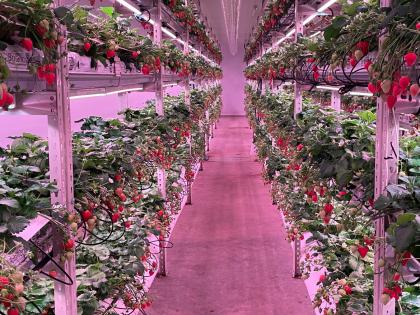
With static returns and rapidly rising production costs, the profitability of strawberry growing in the UK has become marginal, with some growers making losses causing them to cease production. This declining home production has led to increased imports of strawberries, highlighting the need for sustainable home-grown solutions to meet demand, especially out of season.
Unpredictable weather in the UK makes it challenging to reliably produce high yields of high quality strawberries during the traditional growing period so there is increasing interest in Totally Controlled Environment Agriculture (TCEA) strawberry production.
However early attempts at this type of production have not always been successful, in part due to over-vigorous canopy growth due to excessive fertiliser and water use which limits light penetration and increases disease risk. In addition, excess nitrogen can be converted into nitrous oxide which is deemed to be 300 times stronger than carbon dioxide at trapping heat in the atmosphere so there are strong environmental arguments for using nitrogen more effectively.
Niab has previously developed N-demand models for raspberry crops which can reduce fertiliser use by up to 77% while maintaining high Class 1 yields and berry quality, reducing both environmental impact and costs.
The project
In this project, Niab is working with its consortium partners to develop and test a low-nitrogen growing strategy for commercial out-of-season strawberry production in TCEA conditions which will be supplemented with CO2 by employing MOF (Metal-Organic Framework) technology. This allows CO2 to be extracted from the atmosphere and released into the growing environment.
The reduction in nitrogen use will reduce the risk of powdery mildew infection whilst also reducing the number and size of the leaves, leading to the need for less hand leaf removal which will reduce production costs. By supplementing the crop with CO2, the consortium can test whether the photosynthetic capacity of the crop can be maintained or increased, despite having a smaller leaf canopy.
The early work to validate an N-demand model and enrich the crop with CO2 will be carried out at Niab’s East Malling site while in the second year of the project, commercial trials will take place at Flex Farming’s facilities.
Title: TCEA N-demand: Optimising nitrogen and CO2 inputs to improve assimilation and yields in TCEA strawberry production
Funder: Innovate UK
Industry partners: Innophyte Consulting Ltd (Lead) and Flex Farming Ltd
Term: January 2025 to December 2026
Niab researchers


Contact
Niab
Park Farm Campus
Villa Road
Histon
Cambridge
CB24 9AT, UK
Tel: +44(0)1223 342200
Email: [email protected]


Niab Agronomy
Membership

© NIAB 2026