
2025
Regenerative viticulture and climate change resilience
OENO One




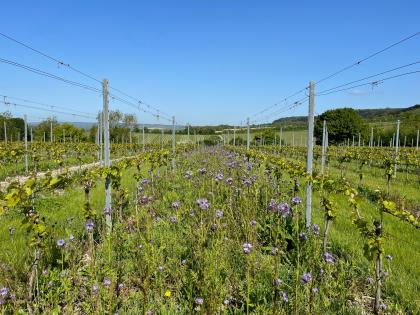
Increasing productivity and sustainability in UK viticulture: investigating the potential of groundcover management practices on soil health, yields and juice quality, and emissions.
Gusbourne
Chapel Down (English Wines PLC)
T Denne & Sons
National Resources Institute (University of Greenwich)
Vinescapes
Defra via Innovate UK
Niab is increasingly aware that poor soil health can give rise to inconsistent grape yields and juice quality, which can lead to costly interventions in the vineyard and winery. Cover crops could play a significant role, by enhancing soil health through their effects on soil carbon content, hydraulic conductivity, biodiversity, and soil structure.
Niab has investigated the potential impact of vineyard groundcover management practices by comparing soil health, vine growth and juice quality between a range of inter-row cover crop treatments, as well as different under-vine management strategies comprising herbicide applications, a mechanical method (under-vine cultivation), and a control using weed strimming alone.
The comparisons were made on three sites including the East Malling Research Vineyard and two commercial vineyard sites at Chapel Down and Gusbourne. The cover crop mixes included phacelia, faba bean, an annual mix of rye and vetch, and a perennial mix containing creeping red fescue and three clover species. The control treatment consisted of alleyways that were maintained as before, with natural/spontaneous vegetation that is regularly mown.
Hot and dry conditions in 2022 resulted in poor establishment of the cover crops, so work was done in that year to compare different methods of sowing and management. Better conditions in 2023 allowed improved establishment enabling comparisons to be made between the crop cover mixes, and the project was extended into 2024 to acquire an extra season of data.
In 2023, some statistically significant results were recorded in the faba bean plots which established particularly well on all sites. There were significantly higher concentrations of soil phosphorus (P) in the faba bean treatment at both the Gusbourne and Chapel Down sites relative to the control, but no differences were found at East Malling. Potential benefits of increased soil P includes enhanced tolerance of the grapevine to copper toxicity, and, in some instances, increased number and weight of clusters and berries. However, it will need careful monitoring since excess soil P can have a negative impact on berry quality.
Other trends appeared over 2023 and 2024. In both years, although not statistically significant, soil nitrate levels in the faba bean plots were much higher than in the control plots at both Gusbourne and East Malling and the same increase was seen on all three sites in 2024 in both faba bean and phacelia plots.
On all three sites, soil moisture levels were lower in all the crop cover treatments compared to the control, suggesting that soil aeration could be improved where crop covers are planted.
In 2023, chlorophyll levels in vine leaves were significantly higher in vines adjacent to faba bean alleyways at both Gusbourne and Chapel Down, and this same trend was observed at East Malling in 2024.
The effect of cover crops on vine canopy varied between years, but there was a trend toward higher vigour in vines adjacent to faba bean and phacelia at all three sites in 2024. It is surmised that this may have resulted from the additional nitrate measured in these plots. In addition, the annual mix of rye and vetch at East Malling and Gusbourne was associated with increased vigour in 2024. This may require additional management interventions to limit the increased disease pressure and reduced grape juice quality that can result from high vigour.
In terms of grape juice quality, significantly higher levels of yeast assimilable nitrogen (YAN) was recorded in grapes from vines adjacent to the faba beans at Gusbourne compared to the control in 2023. This may be attributed to the nitrogen-fixing capacity of the beans resulting in greater nitrate availability to the vines. In 2024, there were trends showing higher YAN content in all crop cover treatments than in the control treatment, although the increase was not statistically significant.
It should be stressed that we can’t draw firm conclusions from these results as the findings were not repeated in both years of the trial and in some cases, only trends have been recorded. However, the work has demonstrated that cover crops can benefit several aspects of soil health (improved nutrient content, better water management) and the vine (e.g. chlorophyll content, YAN). Vine growers considering using cover crops are encouraged to think carefully about how best to establish them, seek guidance from others who have experience of using them and be patient in the early years.
Niab
Park Farm Campus
Villa Road
Histon
Cambridge
CB24 9AT, UK
Tel: +44(0)1223 342200
Email: [email protected]