


2025
Barley BODYGUARD controls cuticular specialisations regulated by SHINE transcription factors
Barley BODYGUARD controls cuticular specialisations regulated by SHINE transcription factors



Facing Forwards aims to understand and exploit variation in epidermal features to future-proof cereal crops to changing climates.
To achieve this, we need to define the genes and developmental mechanisms controlling epidermal properties and how these affect plant performance.
Focusing on barley and wheat, the project explores the coordinating genetic network controlling epidermal traits linked to plant performance. These genes promote cuticular wax deposition as well as formation and spacing of specialised epidermal cells (such as stomata, epidermal hairs and silica cells) which help plants cope with stressful environments.
The project uses fine-scale cuticular profiling and single cell transcriptomics to reconstruct pathways leading to different cell types and cuticular chemistries, alongside mutant alleles in genes known to control specific features. Further, the project also explores the impact of altered epidermal patterning on leaf physiology and function - including stomatal conductance and intrinsic water use efficiency. These approaches will assess spatial and temporal control of epidermal patterning and the physiological impact of trait variation to identify desirable traits and ideotypes for crop production in future climates.
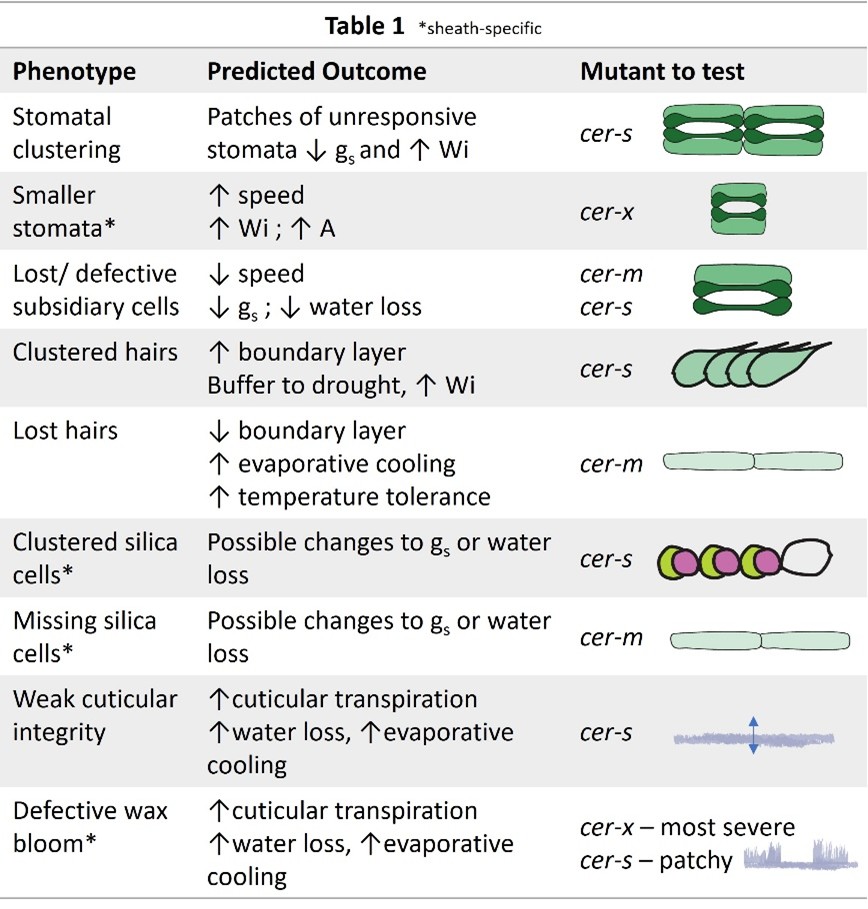
A summary of the genes/genetic loci investigated in the project, and their predicted effect on plant physiology. Source: Sarah McKim, University of Dundee.
2024-2027



Niab
Park Farm Campus
Villa Road
Histon
Cambridge
CB24 9AT, UK
Tel: +44(0)1223 342200
Email: [email protected]