- About
-
Research
- Agronomy and farming systems
-
Agricultural crop research
-
Research projects - agriculture
- About SASSA-SAI
- CTP for Sustainable Agricultural Innovation
- Climate Ready Beans - workshop presentations (March 2022)
- Crop diversity HPC cluster
- Final project workshop
- Get involved
- List of materials
- News and updates
- Partners
- The research team
- UK Cereal Pathogen Virulence Survey
- UK wheat varieties pedigree
- Weed management - IWM Praise
- Crop breeding
- Crop characterisation
- Data sciences
- Genetics and pre-breeding
- Plant biotechnology
- Plant pathology and entomology
- Resources
-
Research projects - agriculture
- Horticultural crop research
- Crop Science Centre
- Research Projects
- Research Publications
-
Services
- Analytical Services
- Commercial trial services
- Membership
- Plant breeding
- Plant characterisation
- Seed certification
-
Training
-
Technical agronomy training
- Advanced crop management of bulb onions
- Advanced crop management of vegetable brassicas
- Advanced nutrient management for combinable crops
- Benefits of cover crops in arable systems
- Best practice agronomy for cereals and oilseed rape
- Developing a Successful Strategy for Spring Crops
- Disease Management and Control in Cereal Crops
- Incorporating SFI options into your rotation
- Protected Environment Horticulture – Best Practice
- Techniques for better pest management in combinable crops
- Crop inspector and seed certification
- Licensed seed sampling
-
Technical agronomy training
- News & Views
- Events
-
Knowledge Hub
-
Alternative and break crops
- POSTER: Domestic production of plant-based protein (2026)
- POSTER: Understanding the lifecycle of cabbage stem flea beetle (2026)
- POSTER: Domestic chickpea production (2025)
- POSTER: Prospects for domestic plant-based protein (2025)
- POSTER: Alternative protein crops & sources (2022)
- POSTER: Undersowing forage maize (2025)
-
Crop genetics
- POSTER: Diversity enriched wheat (2026)
- POSTER: Genetics of wheat flag leaf size (2024)
- POSTER: Wheat yield stability (2024)
- PRESENTATION: Plant breeding for regen ag
- POSTER: Improving phenotyping in crop research (2022)
- POSTER: wild wheat fragment lines (2022)
- Poster: Traits for future cereal crops (2022)
- Poster: Designing Future Wheat (2020)
- Crop nutrition
-
Crop protection
- POSTER: Disease control in barley (2026)
- POSTER: Disease control in winter wheat (2026)
- POSTER: Fungicide resistance research (2026)
- Poster: Implementing IPM (2026)
- Poster: Testing the performance of biofungicides in winter wheat
- POSTER: UKCPVS winter wheat rusts - 2025 review (2026)
- POSTER: UKCPVS winter wheat yellow rust in spring 2025 (2026)
- POSTER: UKCPVS disease monitoring and the benefit to UK growers (2025)
- POSTER: Diagnosing and scoring crop disease using AI (2025)
- POSTER: Finding new sources of Septoria resistance (2024)
- POSTER: Detecting air-borne pathogens (2024)
- POSTER: Oilseed rape diseases (2024)
- POSTER: Improving chocolate spot resistance (2022)
- Poster: Pathogen diagnostics (2022)
- Fruit
-
Regen-ag & sustainability
- Poster: CHCx3 - herbal leys for carbon capture (2026)
- Poster: CHCx3 - growing flax for carbon capture (2026)
- Poster: CHCx3 - growing fibre crops (2026)
- Poster: Old crops feeding the bioeconomy (2026)
- POSTER: CHCx3 - maximising carbon storage from cover crops (2026)
- POSTER: Reducing GHG emissions from wheat production (2026)
- POSTER: CHCx3 - increasing carbon capture through cropping (2026)
- Poster: Finding a balance for productive lowland peat systems (2026)
- POSTER: Crops for the future (2024)
- POSTER: CHCx3 - increasing carbon capture in grasslands (2024)
- POSTER: More wheat/ha tackles climate change (2024)
-
Seed certification
- POSTER: Wheat DUS (2024)
- POSTER: Innovation in variety testing (2024)
- POSTER: AI and molecular markers for soft fruit (2024)
- POSTER: Barley crop identification (2023)
- POSTER: Herbage grass crop identification (2023)
- POSTER: Herbage legume crop identification (2024)
- POSTER: Minor cereal crop inspecting (2023)
- POSTER: Pulse crop identification (2023)
- POSTER: Wheat crop identification (2023)
-
Soils and farming systems
- POSTER: Saxmundham - modern P management learnings (2026)
- POSTER: Saxmundham - 125 years of phosphorus management (2026)
- POSTER: Soil structure and organic matter (2026)
- Poster: Soil phosphorus - availability, uptake and management (2026)
- POSTER: Morley long term experiments (2026)
- POSTER: Exploiting novel wheat genotypes for regen-ag (2026)
- Poster: Soil invertebrates within arable rotations (2024)
- POSTER: The impact of rotations & cultivations (2024)
- POSTER: Soil & agronomic monitoring study (2024)
- POSTER: Impact of prolonged rainfall on soil structure (2024)
- POSTER: Checking soil health - step by step (2024)
- POSTER: Checking soil health - across space and time (2024)
- POSTERS: Changing soil management practices (2022)
- Poster: Monitoring natural enemies & pollinators (2021)
- Video: New Farming Systems project (2021)
- Video: Saxmundham Experimental Site (2021)
- VIDEO: Soil health assessment (2021)
- VIDEO: Great Soils; soil sampling guidelines (2020)
- Varieties
-
Weed management
- Poster: Reducing weed seedbanks for long-term weed control (2026)
- Poster: The growing threat of brome (2026)
- Poster: The growing threat of ryegrass (2026)
- POSTER: Understanding the hierarchy of black-grass control (2026)
- POSTER: Mode of action (2026)
- POSTER: Emerging weed threats (2026)
- POSTER: Weed seed predation in regen-ag (2024)
- POSTER: Inter-row cultivation for black-grass control (2022)
- Poster: Management of Italian ryegrass (2021)
- Video: Inter-row cultivations for black-grass control (2020)
- ADOPT
-
Alternative and break crops

Developing wildflower mixes dedicated to UK fruit crops
Status:
Complete
Title: BEESPOKE
Funder: European Regional Development Fund
Industry partners: Policy makers, research institutes and agronomists from seven different north sea region countries including UK, Belgium Netherlands, Germany, Denmark, Norway and Sweden
Term: April 2019 to March 2023
Project leader: Michelle Fountain, Niab
Niab was a partner of BEESPOKE, an EU funded project which sought to increase the number of pollinators and crop pollination on a local and landscape scale by providing expertise, tools and financial knowledge to support growers across the North Sea region. Flower rich semi-natural grassland is the main habitat that supports pollinators, but by 1984, in lowland England and Wales, the area had declined by 97% compared to the previous 50 years, with only 7,500 hectares remaining by 2010. Fruit crops benefit from wildflower rich habitats, not only in the provision of pollinators to maximise yields, but also for the provision of beneficial insects which help to regulate populations of insect pests. Fruit farms therefore will benefit from the establishment of flower rich habitats, which can help to replace at least some of the semi-natural grassland area that has been lost.
The project
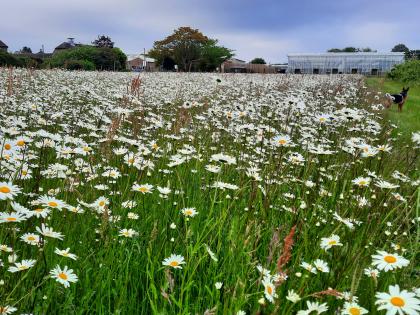
One of the aims of the project was to develop a range of seed mixes for planting on farms to help reverse the decline in pollinators. These have been targeted at the types of pollinators needed by each crop type. Some were sown at demonstration centres such as Niab’s East Malling site to evaluate how effective they are by increasing not only the levels and types of pollinators visiting the strips, but also whether they increase numbers in the crops, and whether this has a subsequent impact on crop yield and quality.
Results
Impact of wildflowers on fruit crops
Niab assessed and recorded the impact of wildflower strips at East Malling over the life of the BEESPOKE project. Early data suggested that wildflowers outside tunnel-grown soft fruit crops did not compete with flowering crops for visits by commercially installed bumblebees inside the tunnels. Indeed the fluorescent tracer marked bumblebees visited the crop flowers far more than the adjacent wildflowers. In raspberry crops, adjacent wildflowers enhanced the number of insect pollinator visits to the crop. This would dispel any concerns commercial growers might have about wildflowers competing with their crop for pollinators.
Research in apple orchards demonstrated how over three seasons, with alleyway sowings of knapweed, yarrow, oxeye daisy, bird’s foot trefoil, self-heal, red campion and red clover, tree populations of predatory spiders, hoverflies, anthocorids and lacewings increased, while numbers of codling moth decreased. Early season aphids, such as rosy apple aphid, decreased in some years but not others, while rust mite increased in one season. Niab also identified adult thrips in wildflowers and found species and numbers fluctuated between years but the majority of thrips recorded were not species damaging to strawberry. Further work is required in soft fruit crops to understand more about this relationship.
The Niab entomology team is also of the view that there will be a greater impact of natural enemies if the wildflowers are positioned within the crop rather than around the field margin. They also recorded an increased diversity of invertebrates in soils where wildflowers were sown, compared to single species mixes, potentially having a positive impact on soil health.
Niab organised a dedicated BEESPOKE event at East Malling in October 2022.
Developing wildflower mixes for UK fruit crops
When setting about developing Beespoke wildflower mixes for our different UK fruit crops, our scientists gave serious thought to the structure, size and composition of the areas to be established and how they should be managed.
It is important to include species that provide height to the mix, which provides improved habitat for insects and an increased biomass which is good for carbon capture. As a result, mowing should be kept to a minimum and if it must be carried out, it is better to mow every other crop row or in the case of large wildflower areas, only half the area. Ideally, the height should be maintained at a minimum of 20cm. If there has been little rainfall a single cut in the Autumn may be all that is needed.
Although semi-natural habitats are important habitat for pollinators and beneficials, alongside ditches, native hedgerows and woodlands (for nesting and shelter), purpose-sown flora can be tailored to specific needs, so growers can gain a lot of pollen and nectar resource from a small area. Some studies recommend a minimum of 6% natural habitat and ideally up to 10%. In addition, a total of 1km of flowering hedgerow per farm can be sufficient to support six common pollinator species. It is generally felt that several small habitat rich areas are more beneficial than one large area for supporting butterfly and parasitoid species. Should one large area fail or be damaged in any way, there are no alternatives, so several smaller areas provide a fall back in case of failure of one. Different areas can also host different seed mixes to further diversify on-farm biodiversity.
The seed mixes should ideally provide diversity of species which complement wildflower species that are already present in or around the farm. The mix should provide flowers outside of the crop flowering period, thereby extending the provision of pollen and nutrients, which can maintain insect population stability and fecundity. Late flowering species help insects to complete their lifecycle thereby helping them to survive from year to year.
When developing an optimum seed mix for each fruit crop, the scientists considered which bee and hoverfly species most commonly visit the crop, which non-crop flowers they visit most often, and which are likely to thrive in a sown area or regenerated strip. They undertook literature searches to identify the pollinators that visit each crop and ranked them according to the frequency of their visits.
Having chosen the top five or six pollinators, they considered the non-crop wildflowers most commonly visited by each pollinator and produced a final choice of seed for each fruit crop including annuals, perennials, biennials and weed species that will attract the five or six pollinators. Not all species will thrive on every site, and for each mix, there is a caveat that some flowering species may have potential to harbour crop pests or diseases, allowing growers to make informed decisions about their final choice of mix.
Some flower species were included repeatedly in a number of the crop mixes, including bird’s foot trefoil, dead nettle, clover, yarrow, hawksbeard and dandelion. Some are long flowering species and some are late flowering.
Niab has produced guides to selecting suitable seed mixes for all UK fruit crops and these can be found on the BEESPOKE website. In addition, other very helpful guides, evaluation tools and publications for growers have been produced as part of the project and are available on the website, including ‘Monitoring pollinators’, ‘Estimating pollination potential’, ‘Establishing perennial wildflower areas’ and ‘Supporting pollinators and farmland biodiversity’.
Niab researchers


Contact
Niab
Park Farm Campus
Villa Road
Histon
Cambridge
CB24 9AT, UK
Tel: +44(0)1223 342200
Email: [email protected]


Niab Agronomy
Membership

© NIAB 2026