
Developing new biocontrol for large raspberry aphid
Status:
Complete

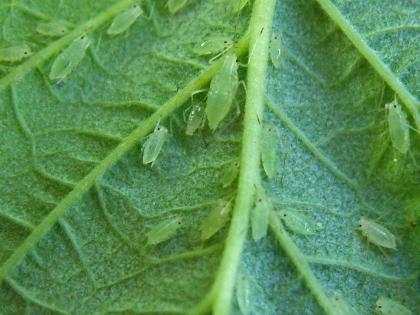
Title: A phenology-perceptive integrated biocontrol programme for Large raspberry aphid (Amphorophora idaei) control: PHENCONTROL
Funder: Growing Kent & Medway and Innovate UK
Industry partners: Asplins PO, Biobest, Rumwood Green Farm
Term: May 2023 to May 2025
Control of aphids on raspberry was relatively simple in the past, with a wide selection of aphicides available to UK growers. However a progressive withdrawal of control products over the past decade or more has left raspberry growers with few effective options. Early season population increases of the large raspberry aphid have become particularly common in glasshouse and protected crops and despite relying on biological control options, levels of control have been inadequate, in part because their deployment has not aligned with seasonal variations in aphid populations and crop growth. Previous genetic resistance bred into raspberry varieties is also absent in modern cultivars. Improved forms of management and control are urgently needed.
The project
Niab aimed to develop an integrated biocontrol programme for raspberry that provides adequate protection against aphid herbivory and damage across all stages of aphid and raspberry phenology. We chose three routes to achieve this, firstly by trying to identify an optimal parasitoid species mix which will spread uniformly across the plantation. We also set out to investigate novel ways of spreading Chrysoperla carnea (green lacewing) eggs across plantations to control hot-spot outbreaks of aphids whilst testing a strategy to deploy Micromus angulatus (brown lacewing) for predation of aphid eggs and spring hatching female aphids, when temperatures are still low.
Results
In the early parasitoid work, the scientists worked with growers to monitor and identify the most prevalent naturally occurring parasitoids found in their crops over the course of the growing season. Between April and June, the parasitic wasp Aphidius ervi was most commonly recorded. Interestingly, other parasitoid species in the Aphidius genus, currently not in the parasitoid mixes were also found, especially later in the season. In later work when the Niab team assessed an integrated biological control approach, these Aphidius species appeared to dominate the total number of species identified. These findings will be used by industry partner Biobest when refining the mix of parasitoids they offer to their commercial customers.
In the work on Chrysoperla carnea (green lacewing), the strategy was to develop a method of applying eggs to areas of the crop where ‘hot-spots’ of large raspberry aphids are found. The challenge was to find a method of applying the eggs to the crop in a way that ensured that they would land and stick to the affected leaves. Different adjuvants carrying the eggs were compared to a water control. A highly diluted solution of food grade Xanthan gum provided the best suspension of the eggs in solution and level of adherence to the leaves and better than the other products tested and the water control. Importantly, the percentage rate of egg hatch on the raspberry leaves of eggs deployed in this manner was comparable to the control group proving that this method would not compromise biocontrol.
In the Micromus angulatus (brown lacewing) work, the hope was to find a way of controlling eggs and spring-hatching female aphids very early in the season before populations of large raspberry aphid began to rise. In this work the Niab team applied aphid eggs to a commercial crop of Malling Bella early in the season to establish early aphid colonies, then made weekly introductions of Micromus angulatus starting on 21st March. The aphid colonies were tagged before introductions began and monitored over the duration of the trial.
Concurrent assessments of both pests and predators were made. A reduction in aphid numbers began to take place by mid-April compared to the untreated control indicating that the brown lacewings were having a positive effect. The investigation also identified that Micromus angulatus will start to predate aphid eggs and adults at 12oC and above. The numbers of naturally occurring insects were monitored alongside the aphids and brown lacewings. This provided valuable insights into the pest and predator dynamics that occur in early spring-time.
Further work was carried out in the autumns of 2023 and 2024 where aphids and natural enemies in both the crop and neighbouring hedgerow habitats were sampled until leaf fall, with the intention of identifying species which might endure the winter seasons thereby offering an early level of control the following spring. Higher numbers of aphids were recorded in 2023 than in 2024, but numbers of lacewings and parasitoids were also higher in that year, suggesting that the predator and parasitoid numbers reflected the pest populations.
In a final piece of work, Niab linked up with Rumwood Green Farm to deploy and evaluate a fully integrated biological control (IBC) programme for the large raspberry aphid. The team recorded the release of commercially available aphid parasitoids and other biocontrol products and sampled crops for aphids at each chosen site on nine occasions during the spring and summer of 2024. Mixes of commercially available parasitoids were released fortnightly, while green lacewing eggs were applied to aphid hotspots at a release rate of 30-50 eggs per square metre.
Unfortunately, very low numbers of aphids were recorded in 2024 during this trial period, so the results were inconclusive and an additional season would be required to confirm any major findings. However, the growers involved in the work are of the view that despite an IBC programme being more expensive, they would expect that long-term establishment and persistence of parasitoids and other natural enemies should offer incremental yield and cost benefits to growers over successive seasons.
While further work would be valuable to demonstrate the cost-effectiveness of these approaches in commercial raspberry production, this project has yielded important, actionable findings for growers, industry, and researchers alike. A key scientific outcome is the identification of parasitoid species present within raspberry plantations, offering potential to enhance control of the large raspberry aphid. This warrants further investigation, enabling Biobest to refine its commercial biological control products for raspberry growers. In addition, the project has developed a promising method for applying green lacewing eggs, which could reduce labour requirements.
Rather than relying on manual application to aphid ‘hot-spots’, prophylactic spraying of lacewing eggs may suffice; the eggs would adhere to raspberry foliage, hatch, and provide more uniform aphid control across the crop. Products using this methodology are already authorised in the USA, and were the UK to resolve the current regulatory barriers, such an approach would represent a valuable addition to the tools available for aphid management.
Finally, the finding that brown lacewings will prey on large raspberry aphid at temperatures as low as 12°C adds further value. This insight is particularly relevant for early-season aphid control and is likely to be of particular interest to organic growers. Together, these findings provide a practical foundation for improving aphid control in raspberry crops, with immediate relevance for growers and scope for future innovation.
Contact
Niab
Park Farm Campus
Villa Road
Histon
Cambridge
CB24 9AT, UK
Tel: +44(0)1223 342200
Email: [email protected]


Niab Agronomy
Membership

© NIAB 2026