
2018
Reducing Drosophila suzukii emergence through inter‐species competition
Pest Management Science


Title: Exploitation of interspecific signals to deter oviposition by spotted wing drosophila
Funder: Biotechnology and Biology Science Research Council
Industry partners: University of Greenwich (Lead), Berry Gardens Growers Ltd, University of Southampton
Term: January 2019 to June 2022
Previous research by Niab discovered that Drosophila suzuki (Spotted Wing Drosophila - SWD) lays fewer eggs on media previously visited by Drosophila melanogaster, the common fruit fly, which only tends to lay its eggs on ripe and overripe fruits, unlike SWD, which also lays eggs on under-ripe fruits. The project hypothesis was to try and identify what exactly is deterring SWD from laying eggs after D. melanogaster has visited, so that this compound might be employed as a control strategy in commercial crops.
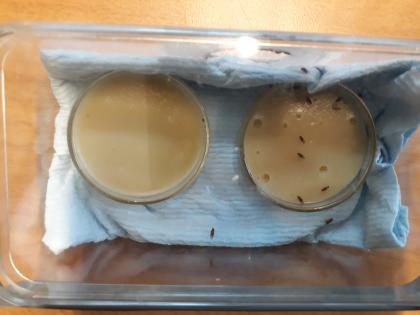
The aim of this project was to understand SWD egg laying behaviour and to investigate how interactions with other Drosophila species affect SWD egg laying (oviposition). The work was carried out in the laboratory by a researcher, Trisna Tungadi, at East Malling. Trisna exposed D. melanogaster adults (male and female) to egg laying media before exposing the same media to SWD adults alongside a fresh media plate for comparison.
The first experiment confirmed previous research, with fewer eggs laid by SWD on the plate that had previously been exposed to D. melanogaster. The next question was to find out which life stage and what D. melanogaster had left on those plates to deter SWD from laying its eggs. Further work discovered that the presence of live D. melanogaster larvae always resulted in fewer eggs being laid by SWD, rather than the presence of adult D. melanogaster.
Biochemical research was done to assess cuticular hydrocarbons found in the larvae of both D. melanogaster and SWD. Both species shared some compounds but also species specific cuticular hydrocarbons were identified. A synthetic blend of the D. melanogaster cuticular hydrocarbons was made and spread on egg laying media, but unfortunately this did not deter SWD laying eggs. Further work has been investigating whether other compounds left by D. melanogaster larvae deter SWD from laying eggs.
Niab
Park Farm Campus
Villa Road
Histon
Cambridge
CB24 9AT, UK
Tel: +44(0)1223 342200
Email: [email protected]