- About
-
Research
- Agronomy and farming systems
-
Agricultural crop research
-
Research projects - agriculture
- About SASSA-SAI
- CTP for Sustainable Agricultural Innovation
- Climate Ready Beans - workshop presentations (March 2022)
- Crop diversity HPC cluster
- Final project workshop
- Get involved
- List of materials
- News and updates
- Partners
- The research team
- UK Cereal Pathogen Virulence Survey
- UK wheat varieties pedigree
- Weed management - IWM Praise
- Crop breeding
- Crop characterisation
- Data sciences
- Genetics and pre-breeding
- Plant biotechnology
- Plant pathology and entomology
- Resources
-
Research projects - agriculture
- Horticultural crop research
- Crop Science Centre
- Research Projects
- Research Publications
-
Services
- Analytical Services
- Commercial trial services
- Membership
- Plant breeding
- Plant characterisation
- Seed certification
-
Training
-
Technical agronomy training
- Advanced crop management of bulb onions
- Advanced crop management of vegetable brassicas
- Advanced nutrient management for combinable crops
- Benefits of cover crops in arable systems
- Best practice agronomy for cereals and oilseed rape
- Developing a Successful Strategy for Spring Crops
- Disease Management and Control in Cereal Crops
- Incorporating SFI options into your rotation
- Protected Environment Horticulture – Best Practice
- Techniques for better pest management in combinable crops
- Crop inspector and seed certification
- Licensed seed sampling
-
Technical agronomy training
- News & Views
- Events
-
Knowledge Hub
-
Alternative and break crops
- POSTER: Domestic production of plant-based protein (2026)
- POSTER: Understanding the lifecycle of cabbage stem flea beetle (2026)
- POSTER: Domestic chickpea production (2025)
- POSTER: Prospects for domestic plant-based protein (2025)
- POSTER: Alternative protein crops & sources (2022)
- POSTER: Undersowing forage maize (2025)
-
Crop genetics
- POSTER: Diversity enriched wheat (2026)
- POSTER: Genetics of wheat flag leaf size (2024)
- POSTER: Wheat yield stability (2024)
- PRESENTATION: Plant breeding for regen ag
- POSTER: Improving phenotyping in crop research (2022)
- POSTER: wild wheat fragment lines (2022)
- Poster: Traits for future cereal crops (2022)
- Poster: Designing Future Wheat (2020)
- Crop nutrition
-
Crop protection
- POSTER: Disease control in barley (2026)
- POSTER: Disease control in winter wheat (2026)
- POSTER: Fungicide resistance research (2026)
- Poster: Implementing IPM (2026)
- Poster: Testing the performance of biofungicides in winter wheat
- POSTER: UKCPVS winter wheat rusts - 2025 review (2026)
- POSTER: UKCPVS winter wheat yellow rust in spring 2025 (2026)
- POSTER: UKCPVS disease monitoring and the benefit to UK growers (2025)
- POSTER: Diagnosing and scoring crop disease using AI (2025)
- POSTER: Finding new sources of Septoria resistance (2024)
- POSTER: Detecting air-borne pathogens (2024)
- POSTER: Oilseed rape diseases (2024)
- POSTER: Improving chocolate spot resistance (2022)
- Poster: Pathogen diagnostics (2022)
- Fruit
-
Regen-ag & sustainability
- Poster: CHCx3 - herbal leys for carbon capture (2026)
- Poster: CHCx3 - growing flax for carbon capture (2026)
- Poster: CHCx3 - growing fibre crops (2026)
- Poster: Old crops feeding the bioeconomy (2026)
- POSTER: CHCx3 - maximising carbon storage from cover crops (2026)
- POSTER: Reducing GHG emissions from wheat production (2026)
- POSTER: CHCx3 - increasing carbon capture through cropping (2026)
- Poster: Finding a balance for productive lowland peat systems (2026)
- POSTER: Crops for the future (2024)
- POSTER: CHCx3 - increasing carbon capture in grasslands (2024)
- POSTER: More wheat/ha tackles climate change (2024)
-
Seed certification
- POSTER: Wheat DUS (2024)
- POSTER: Innovation in variety testing (2024)
- POSTER: AI and molecular markers for soft fruit (2024)
- POSTER: Barley crop identification (2023)
- POSTER: Herbage grass crop identification (2023)
- POSTER: Herbage legume crop identification (2024)
- POSTER: Minor cereal crop inspecting (2023)
- POSTER: Pulse crop identification (2023)
- POSTER: Wheat crop identification (2023)
-
Soils and farming systems
- POSTER: Saxmundham - modern P management learnings (2026)
- POSTER: Saxmundham - 125 years of phosphorus management (2026)
- POSTER: Soil structure and organic matter (2026)
- Poster: Soil phosphorus - availability, uptake and management (2026)
- POSTER: Morley long term experiments (2026)
- POSTER: Exploiting novel wheat genotypes for regen-ag (2026)
- Poster: Soil invertebrates within arable rotations (2024)
- POSTER: The impact of rotations & cultivations (2024)
- POSTER: Soil & agronomic monitoring study (2024)
- POSTER: Impact of prolonged rainfall on soil structure (2024)
- POSTER: Checking soil health - step by step (2024)
- POSTER: Checking soil health - across space and time (2024)
- POSTERS: Changing soil management practices (2022)
- Poster: Monitoring natural enemies & pollinators (2021)
- Video: New Farming Systems project (2021)
- Video: Saxmundham Experimental Site (2021)
- VIDEO: Soil health assessment (2021)
- VIDEO: Great Soils; soil sampling guidelines (2020)
- Varieties
-
Weed management
- Poster: Reducing weed seedbanks for long-term weed control (2026)
- Poster: The growing threat of brome (2026)
- Poster: The growing threat of ryegrass (2026)
- POSTER: Understanding the hierarchy of black-grass control (2026)
- POSTER: Mode of action (2026)
- POSTER: Emerging weed threats (2026)
- POSTER: Weed seed predation in regen-ag (2024)
- POSTER: Inter-row cultivation for black-grass control (2022)
- Poster: Management of Italian ryegrass (2021)
- Video: Inter-row cultivations for black-grass control (2020)
- ADOPT
-
Alternative and break crops

Following the trail of oat crown rust: a UK isolate connects to the USA
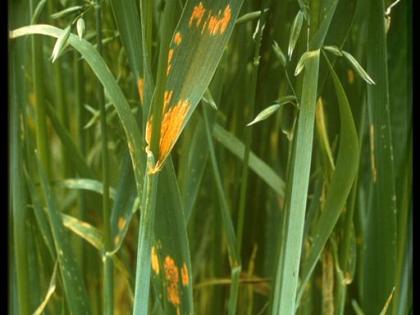
Niab has played an important role in an international pathogenomics study including providing a uniquely preserved oat crown rust sample collected in the UK back in 1984.
Pathogen genomics often feels like a forward-looking field: new sequencing methods, larger datasets, and more powerful analysis. But some of the most useful insights can come from looking back.
An international collaborative study led by Prof. Melania Figueroa (CSIRO, Australia), published online in Molecular Plant-Microbe Interactions, explores the global population structure of the oat crown rust pathogen (Puccinia coronata f. sp. avenae). The study uses haplotype-resolved, chromosome-scale genome assemblies from isolates collected across multiple continents over several decades.
One of the key findings is that some pathogen haplotypes can persist for a surprisingly long time and can move between continents with little change. In particular, one haplotype links a UK isolate collected in 1984 with isolates sampled in the USA in 1990 and again in 2017.
Why does this matter?
Oat crown rust is a fast-evolving pathogen. In some regions, especially where its alternate host (for example common buckthorn) is in abundance, sexual reproduction can generate high genetic diversity and rapid shifts in virulence. In other regions, populations are thought to be mostly asexual, dominated by clonal lineages that change more slowly.
This genome-wide analysis suggests these clonal lineages can be long-lived. Finding a nearly identical nuclear haplotype in isolates separated by more than 30 years, and thousands of miles, supports the idea that some clonal haplotypes persist globally. They may occasionally move between lineages through nuclear exchange and are only rarely reshuffled by sexual recombination.
This challenges the assumption that older isolates are necessarily “obsolete”, or that modern populations are always made up of recently evolved haplotypes.
The role of a UK historic isolate
Niab contributed pathotyping data for a UK oat crown rust isolate sampled in 1984 and well preserved in the Niab collection of cereal rust isolates, along with high-quality, high-molecular-weight genomic DNA suitable for long-read sequencing, and fungal spore preparations for high-throughput chromosome conformation capture (Hi-C) sequencing. These materials enabled a fully phased, chromosome-scale genome assembly for this old isolate. That assembly proved very informative. One of its two nuclear haplotypes is nearly identical to a haplotype found in North American isolates collected decades later. Without a phased genome from the 1984 UK isolate, this long-term persistence, and what it tells us about global population structure, would have been much harder to detect.
This is a good example of how well-curated archival material can greatly increase the value of modern sequencing.
Beyond a single result
More broadly, the study generated haplotype-resolved genomes from ten oat crown rust isolates originating from Europe, Africa, and the Middle East. This expanded the collection to 52 haplotypes from 26 isolates worldwide.
Together, these data point to a global population largely made up of long-lived clonal lineages, with occasional nuclear exchange events and rare sexual recombination.
The work also highlights how different evolutionary processes can operate side-by-side: long-term stability of whole haplotypes, alongside more dynamic changes in gene content, effector repertoires, and gene expression. For disease surveillance and resistance breeding, this combination of persistence and flexibility is both challenging and important to understand.
Additional take-home messages
This story is a useful reminder that historic isolates can be scientifically invaluable, and that maintaining pathogen collections can pay dividends decades later. It also reinforces that high-quality sample preparation remains critical for getting the most out of downstream sequencing and bioinformatics. And sometimes, even a single isolate can change how we think about an entire pathogen population.
Contact
Niab
Park Farm Campus
Villa Road
Histon
Cambridge
CB24 9AT, UK
Tel: +44(0)1223 342200
Email: [email protected]


Niab Agronomy
Membership

© NIAB 2026