
Developing sustainable pest and pathogen control in coir substrate
Status:
Complete

Title: Reducing the risk of oomycete pathogens, thrips and weevils for sustainable, coir based soft fruit production
Funder: Biotechnology and Biological Sciences Research Council
Industry partner: Overland Ltd
Term: March 2023 to November 2023
The UK soft fruit industry has moved almost entirely from soil based production into virgin coir substrate which is normally used for a single growing season. By growing in a clean substrate, the incidence of soil borne pests and diseases has decreased, but a number of pests and pathogens continue to adversely affect fruit yields and quality, requiring management interventions. Recently, recycling of spent coir media has been investigated as a more economic and sustainable approach. Recycled material however is associated with a much higher risk of pests and pathogens. A sustainable approach to prevent or reduce the risk of pests and pathogens in virgin and recycled coir media has been urgently needed.
The project
This project studied the biology of pests, pathogens and biocontrol agents in both virgin and recycled coir. The research aimed to investigate the diversity and function of the microbiome in recycled and virgin coir substrate, and in particular survival and efficacy of biological control agents in virgin and recycled material. We expect recycled material to have a higher diversity of both pathogenic and beneficial microorganisms and also to enable better establishment of added biocontrol agents. The work was done on strawberry crops and to complement Growing Kent & Medway funded work with Overland Ltd on recycling optimisation and practical implementation into growing practice.
Results
The early work aimed to eliminate pest, pathogen and weed risks from recycled coir and a heating process was developed and refined which successfully inactivated pest, pathogen and weed seeds from the substrate. Further work was done to study and compare the microbiome (community of microorganisms) within both virgin and recycled coir. We investigated fungal, bacterial and oomycete organisms in each coir type collected from a commercial scale trial during peak harvest.
A greater biodiversity of fungi was found in virgin coir compared to recycled and within these, we recorded more potential fungal pathogens on the roots of strawberry plants grown in virgin coir compared to recycled. These pathogens included species of Ilyonectria, Neopestalotiopsis, Verticillium, Mucor, Macrophomina and Fusarium. We also found more Colletotrichum and Penicillium species in virgin coir but not all of these are considered pathogenic. In assessing beneficial fungi, we found more Trichoderma (both commercial biocontrol species and others), Metharizhium and Serendipita in virgin coir. In contrast we found more Rhizophagus species (beneficial arbuscular mycorrhizal fungi) in recycled coir.
Bacteria were more diverse in recycled coir, but some were more prevalent in recycled and others in virgin coir. Potentially pathogenic groups were again found to be more abundant in virgin coir.
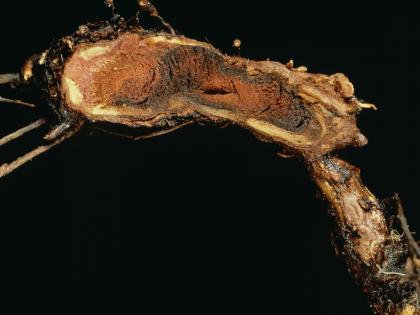
Of the oomycetes (pathogens such as Pythium and Phytopthora species), very similar levels were recorded in virgin and recycled coir. There was a very slight increase in Phytophthora cactorum in recycled coir.
It is worth noting that no disease symptoms were observed on plants grown in virgin or recycled coir.
Niab researchers

Contact
Niab
Park Farm Campus
Villa Road
Histon
Cambridge
CB24 9AT, UK
Tel: +44(0)1223 342200
Email: [email protected]


Niab Agronomy
Membership

© NIAB 2026