
2025
Control of Woolly Apple Aphid (Eriosoma lanigerum) by Augmenting Earwigs (Forficula auricularia) in the Canopy of Apple Trees
Entomologia Experimentalis et Applicata

Title: Novel approaches to pest and disease control in apples and pears
Funder: British Apples and Pears Ltd
Term: April 2023 to March 2024
Project leader: Michelle Fountain
British Apples and Pears Ltd funded Niab to investigate new approaches to controlling a range of pests and diseases. In 2023, we worked on apple canker and apple scab control whilst reviewing IPM techniques for codling moth and brown marmorated stink bug control. In addition, precision monitoring, semiochemical and biological manipulation was investigated to control pests such as apple blossom weevil, capsids and sawfly.
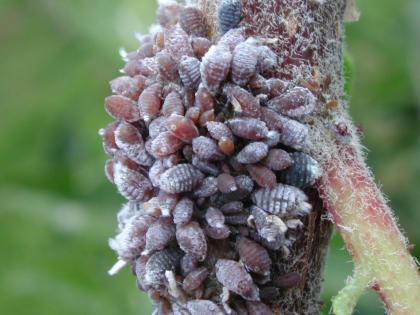
The final part of the work sought to develop natural control methods for woolly apple aphid (WAA), currently one of the most challenging pests for apple growers to manage. The pest used to be successfully controlled by broad-spectrum spray products, but the most effective of these have been withdrawn.
Batavia (spirotetramat) currently has an EAMU authorisation to control woolly apple aphid, but weather conditions and application timing are not always optimum for effective control. Rootstock resistance also used to contribute to control, but recent research by a Niab PhD study demonstrated that WAA has at least partially overcome such genetic resistance in some rootstocks. Alternative natural and biological control methods need to be assessed.
Earwigs (Forficula auricularia) are important generalist predators in both apple and pear, of many pest species including aphids. In pear, previous Defra funded research demonstrated that earwigs contribute significantly to the predation of pear sucker. Wignests were developed in an Innovate UK project and offer shelter for earwigs, spiders, anthocorids and other predators, and where earwigs have been present in such wignests in apple orchards, a reduction in incidence of pest damage caused by codling moth and aphids has been recorded. The wignests are commercially available through Russell IPM. This project set about assessing if earwigs housed in wignests and deployed in apple trees hosting WAA, could reduce WAA colonies and colony size.
Large numbers of earwigs were harvested from other habitats in May and June 2023, housed within wignests and then deployed in apple trees in three different WAA affected orchards. Plots both with and without wignests were compared for WAA numbers in July and August.
Overall, placing wignests containing 5 earwigs each in apple tree canopies did not significantly reduce the numbers of WAA in apple trees in one season. However, a trend was seen, especially on one of the sites, which demonstrated an overall reduction in the numbers of WAA on shoot leaf nodes, especially in the middle of the growing season (July and August) following the deployment of earwig loaded wignests at the end of June.
These results are encouraging, so it has been suggested that this work might be continued to examine the long-term impacts of relocating earwigs to apple orchards both to assess if earwigs return to the wignests in subsequent years, and also to test if re-inoculating the refuges with earwigs in a second year might reduce the WAA numbers further.
Further research might also seek to develop methods of harvesting and redeploying earwigs which are less reliant on labour. Additional research might address recent reports of fewer earwigs in orchards which might have been brought about by changing cultural practices such as less frequent mowing and the incorporation of cover crops.
Niab
Park Farm Campus
Villa Road
Histon
Cambridge
CB24 9AT, UK
Tel: +44(0)1223 342200
Email: [email protected]