

2025
Effects of Regulated Deficit Irrigation on yields, berry quality, and resource use efficiency in the everbearer strawberry Malling Ace under long-term production in TCEA
Frontiers in Horticulture



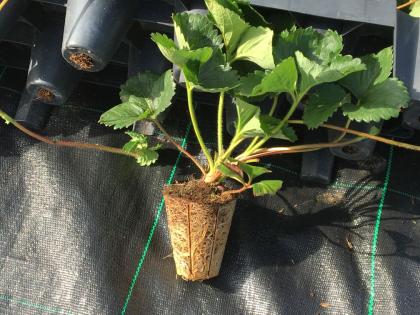
A rapidly expanding population, climate change and uncertain food security require a different approach to food production in the UK. The new challenge is to produce higher yields of high quality crops on smaller areas of land, with reduced inputs, and in closer proximity to local markets. Total Controlled Environment Agriculture (TCEA) growing systems, sometimes known as ‘Vertical Farming’ offer a solution. At the same time, strawberry growers require higher quality healthy plant material which will produce a consistently high yield from every plant, and which can be grown locally to their final cropping location.
Working with a multi-disciplinary team of researchers, technology companies and growers, Niab scientists will develop a method to produce high quality, virus-and disease-free strawberry plant propagules with assured high cropping potential in TCEA systems. The resulting pre-programmed, high-health plant material will enable import substitution of both propagules and fruit (currently £40m and £186M per year), reduce chemical inputs and waste (currently £30m/year), and deliver a product that will provide value and security for growers, when planted in conventional polytunnel systems, glasshouses (CEA) or TCEA.
Title: Optimising the propagation environment in TCEA systems to maximise strawberry yield potential in all production systems
Funder: Defra Farming Innovation Programme
Industry partners: Vertical Future, Berry Gardens Growers Ltd, The Blaise Plant Company Ltd, Cocogreen Ltd, Clockhouse Farm, Delta T Devices, Hugh Lowe Farms Ltd, Linton Growing Ltd, University of Reading
Term: June 2023 to May 2026
Niab
Park Farm Campus
Villa Road
Histon
Cambridge
CB24 9AT, UK
Tel: +44(0)1223 342200
Email: [email protected]