
Niab Landmark: Issue 60 - Spring 2026
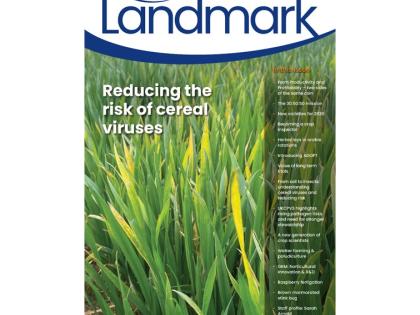
The latest edition of Landmark, Niab's corporate magazine featuring news, research and information from across the organisation, is now available to read and download.
Available to all - access the online flip-book and downloadable PDF versions
Niab Landmark (Issue 60): Spring 2026
Issue 60 features all the new cereal, oilseed and pulse varieties for 2026, introduces the 30:50:50 industry campaign, gives a personal view on Niab's history in training generations of crop inspectors and a summary of the value of long-term trials. We take a dip into herbal leys in arable rotations, the opportunities in paludiculture, provide advice on reducing the risk of cereal viruses, and the latest from UKCPVS work on cereal rusts. And finally, our work in raspberry fertigation and stink bug surveillance in fruit crops is covered, alongside a reflection on Growing Kent & Medway's success in driving horticultural innovation.
In this issue:
- Farm productivity and profitability: Niab CEO Mario Caccamo highlights the need for coherent agricultural policy, stronger research translation, and rapid tech adoption to boost farm productivity, explaining that advances in science, data, and innovation can raise yields, cut emissions, and improve resilience across UK agriculture while safeguarding future capability.
- The 30:50:50 mission: APPGSTA Chair George Freeman MP introduces a new campaign to increase UK farm productivity by 30% by 2050 while halving environmental impact, emphasising innovation, sustainability, and food security.
- New varieties for 2026: Clare Leaman and Colin Peters review the new AHDB Recommended Lists for wheat, barley, oats, oilseeds, and pulse varieties, highlighting their strengths, weaknesses, and suitability for different farming conditions.
- Becoming a crop inspector: Claire Carpenter takes a personal look at Niab’s evolving crop inspector training programmes, emphasising accessibility, technology integration, and adapting to industry needs for certified seed quality assurance.
- Herbal leys in arable rotations: Ellie Roberts examines the benefits and challenges of multi-species herbal leys in improving soil health, biodiversity, and forage production in arable rotations.
- Introducing ADOPT: Elizabeth Stockdale details Niab’s involvement with the ADOPT programme, farmer-led projects to trial new technologies and practices for sustainable agriculture and improved farm productivity.
- Value of long-term trials: Nathan Morris highlights the importance of long-term experiments in understanding farming systems, soil health, and crop productivity, with updates to ensure relevance to modern practices.
- Reducing the risk of cereal viruses: Kostya Kanyuka and Will Vaughan-France explain cereal virus transmission routes, prevention strategies, and Niab’s research on virus resistance and diagnostics for sustainable crop management.
- UKCPVS highlights rising pathogen risks and need for stronger stewardship: Kostya Kanyuka and Charlotte Nellist report from the UKCPVS annual stakeholder meeting, reviewing pathogen risks, resistance gene stewardship, and fungicide resistance trends to maintain effective disease control in UK cereal crops.
- A new generation of crop scientists: Introducing Niab PhD students James Woodward and Ian Tsang, highlighting their research on insect pollination in fruit crops and root hair traits in wheat.
- Wetter farming & paludiculture: Elizabeth Stockdale discusses sustainable farming on lowland peatlands, focusing on rewetting, paludiculture, and reducing greenhouse gas emissions while maintaining agricultural productivity.
- GKM: horticultural innovation & R&D: Simon Barnes reflects on Growing Kent & Medway’s success in driving horticultural innovation, improving food systems, and addressing national health and food security challenges.
- Raspberry fertigation: Mark Else and Scott Raffle explore precision nutrient delivery in raspberry crops, reducing nitrogen and water use while maintaining yields and improving environmental sustainability.
- Brown marmorated stink bug: Francis Wamonje and Scott Raffle detail Niab’s surveillance programme for the invasive pest, its potential impact on UK crops, and efforts to raise awareness and develop control measures.
- Staff profile: Sarah Arnold: Highlighting Sarah’s research on pollination and pest management in UK fruit crops, focusing on sustainable production and improving pollinator performance.
Contact
Niab
Park Farm Campus
Villa Road
Histon
Cambridge
CB24 9AT, UK
Tel: +44(0)1223 342200
Email: [email protected]


Niab Agronomy
Membership

© NIAB 2026