
NOAH: Crop resilience through AI-guided microbiome engineering
Status:
Active
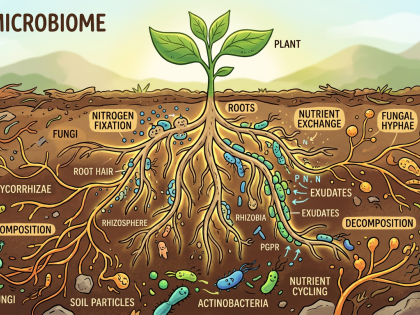
Bioinoculants - microbes that enhance plant growth, nutrient uptake and stress resilience - show great promise, yet their field effectiveness remains inconsistent. Current bioinoculant development depends on empirical evaluation, constrained by limited understanding of microbiome ecology.
The NOAH project will establish the first AI foundation model for crop microbiomes: ARCA (AI-guided Root microbiome engineering for ClimAte-resilient and nutritious crops).
ARCA integrates microbial functional traits, host genotype, and environmental metadata to model and design microbiome configurations that optimise crop performance. ARCA will be trained on curated public microbiome datasets and tailored using high-resolution data from five major crops: wheat, tomato, faba bean, oilseed rape, and apple. Iterative design–build–test–learn (DBTL) cycles under controlled and field conditions ensure a progressive refinement of model accuracy and generalisation.
NOAH aims to identify beneficial microbial consortia and reveal missing functional components in suboptimal microbiomes. This breakthrough AI approach will transform microbiome engineering, accelerating the effective deployment of bioinoculants that enhance crop climate resilience and nutritional quality in a sustainable man
Partners
Utrecht University, Aarhus University, INRA, The Hyve
Funders

Duration
2027-2031
Niab researchers



Contact
Niab
Park Farm Campus
Villa Road
Histon
Cambridge
CB24 9AT, UK
Tel: +44(0)1223 342200
Email: [email protected]


Niab Agronomy
Membership

© NIAB 2026