








AEGIS: Ancient Environmental Genomics Initiative for Sustainability

Status: Active
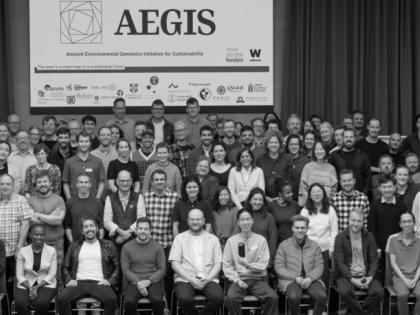
The AEGIS team at a conference

Nature has already run millions of evolutionary “experiments.” By analysing ancient environmental DNA, AEGIS will identify lost genetic traits, ancestral diversity and beneficial species interactions that helped plants survive past stress episodes.
Led by University of Copenhagen, AEGIS will:

  • Reconstruct past ecosystems. By reading ancient environmental DNA alongside climate and archaeological records, AEGIS reveals how ecosystems shifted through periods of climate change and human land use.
  • Trace the evolution of agriculture. The project uncovers how early farming practices and domesticated crops responded to environmental pressures, showing how cultivation systems and plant genomes have changed through thousands of years.
  • Discover natural resilience. By comparing ancient and modern genomes, AEGIS pinpoints genetic adaptations and beneficial interactions - for example, between plants, soils, and microbes - that historically supported stress tolerance and productivity.
  • Translate insights into new solutions. These discoveries provide a foundation for developing climate-smart crops, sustainable land management strategies, and farming systems that strengthen biodiversity while reducing dependency on fertilisers and pesticides.

AEGIS website

Duration

2024-2031

Lead Partner

Other partners

Carlsberg Research Laboratory, EMBL-EBI, Institut Pasteur, Seoul National University, University of Aarhus, University of Bremen, University of California, University of Cambridge, University of Colorado Boulder, University of Zurich, Wageningen, Wellcome Sanger Institute.

Funders


Niab researchers

Dr James Cockram

Group Leader: Trait Genetics

Dr Tansy Chia

Post-doctoral Researcher (Plant Genetics)

Dr Lawrence Percival-Alwyn

Researcher- Molecular Biology and Informatics

Dr Kostya Kanyuka

Head of Pathology