
Niab to lead international drive to accelerate wheat improvement
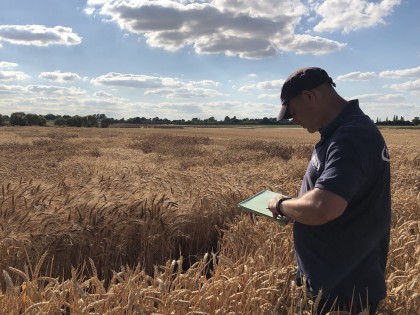
A three-year BBSRC-funded project will create a rapid route for promising wheat traits to move into commercial breeding programmes
Promising advances in wheat research could reach commercial plant breeders – and ultimately onto farm - faster through a new international programme led by the UK crop science organisation Niab. The three-year project will create a rapid pipeline for introducing and testing novel traits in European winter wheat.
Niab has been awarded significant funding from the Biotechnology and Biological Sciences Research Council to lead ‘IWYP v2.0 - a translational hub for international wheat pre-breeding and trait validation’, starting in October.
It is the first major project funded in the second phase of the International Wheat Yield Partnership (IWYP), an international collaboration bringing together research organisations, public funders and private-sector breeding companies to accelerate wheat improvement.
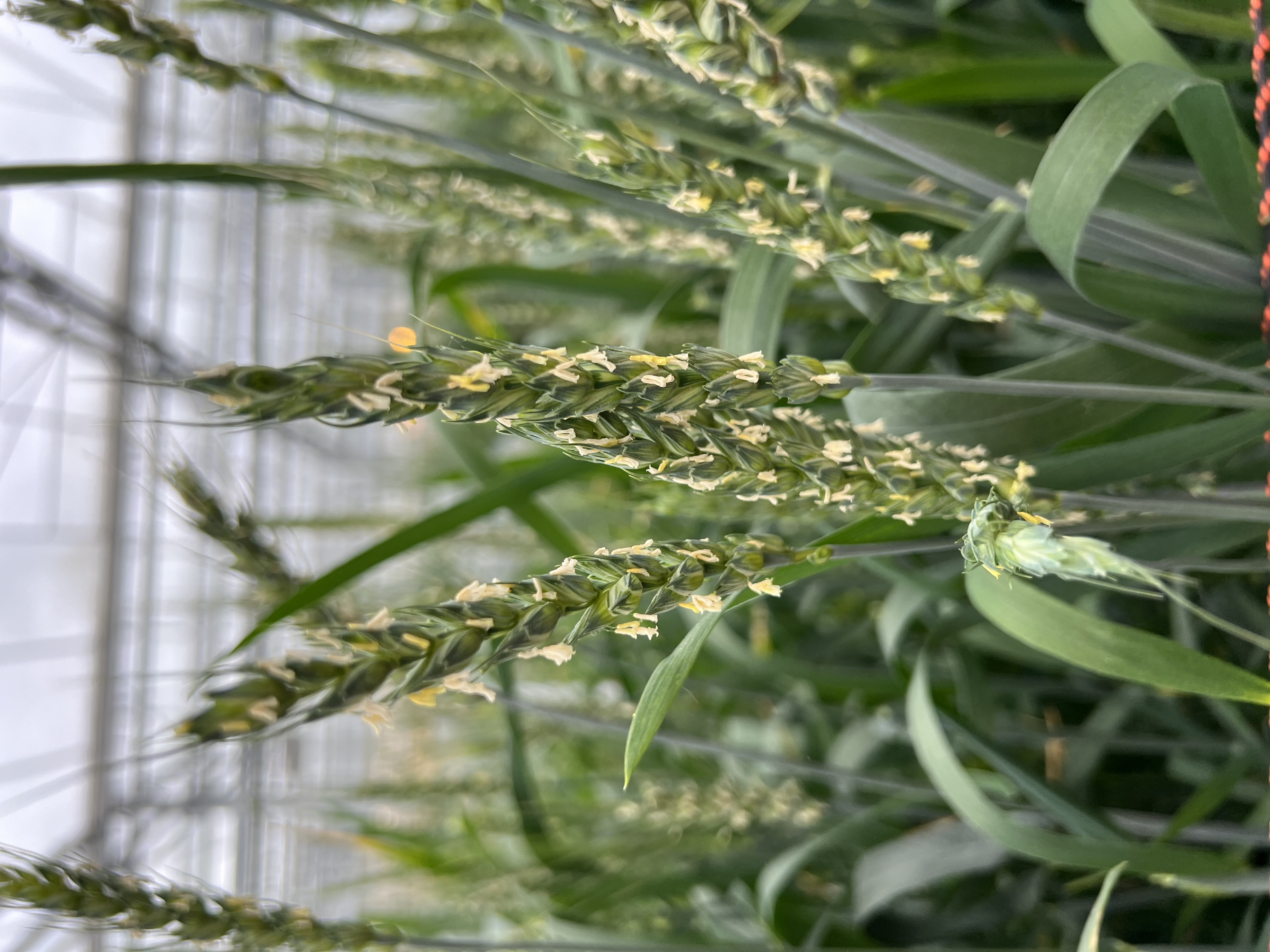
Led by Dr Phil Howell, Crop Improvement Research Lead at Niab, the new Hub will develop a rapid pipeline for introducing and combining novel traits in winter wheat. It will produce advanced pre-breeding lines, carrying promising novel traits in elite European wheat backgrounds, for validation through breeder trial sites across the UK and Europe.
The programme brings Niab together with eight commercial wheat breeding companies and international IWYP Hubs at CIMMYT, Mexico, and Kansas State University and the US Department of Agriculture’s Agriculture Research Service in the USA.
Dr Howell explained that discovering new genes and traits is an important start, but too often these fail to translate into on-farm gains.
“This project allows us to build a rapid route from promising scientific discoveries to advanced pre-breeding material in adapted, high-yielding variety backgrounds. Crucially, these will then be tested thoroughly across different environments in Europe, working directly with commercial breeders to identify which traits will be most valuable to their breeding programmes. It builds on Niab’s longstanding expertise in wheat genetics and pre-breeding and our experience of working internationally with both research organisations and commercial breeding companies,” said Dr Howell.
Niab has been involved in IWYP for several years, including leading its European Winter Wheat Hub, established in 2020. The initial project used marker-assisted breeding to transfer novel traits from unadapted sources into elite European varieties, producing hundreds of advanced pre-breeding lines for evaluation by breeding companies. IWYP 2.0 builds on this experience and more than two decades of Niab research in wheat genetics, genetic resources and pre-breeding, with new investment in pre-breeding pipelines, phenotyping, and field testing at Niab and breeder sites across the UK, France, Germany and Denmark.
Katrina Hayter, CEO of Niab, said: “Being selected to lead the first major project in IWYP’s second phase is a strong endorsement of the wheat science and translational capability our teams have built over many years, and the standing Niab has with BBSRC and our international partners.
“It is exactly the kind of partnership Niab exists to build: public research and commercial breeders working on a shared goal, so that scientific discovery becomes practical gains for breeders and farmers in one of the world’s most important food crops.”
Professor Richard Flavell CBE FRS, chair of the IWYP Scientific and Impact Executive Board, said IWYP’s role is to strengthen global food security by translating advanced wheat research into breeder-ready technologies.
“By integrating public, private, and academic expertise, IWYP accelerates the use of valuable genetic diversity in elite wheat breeding programmes worldwide. Niab will serve as the European Hub of IWYP’s translational research, which will stimulate and facilitate sharing of knowledge and technologies with its other Hubs,” said Professor Flavell.
The IWYP v2.0 Hub will run for three years from October 2026 as part of a ‘Virtual Super Hub’ – a co-ordinated international programme to accelerate genetic improvement in wheat.
Contact
Niab
Park Farm Campus
Villa Road
Histon
Cambridge
CB24 9AT, UK
Tel: +44(0)1223 342200
Email: [email protected]


Niab Agronomy
Membership

© NIAB 2026