
NEWS: Alternative crop display on NIAB Cereals 2023 stand
NIAB is demonstrating options for more resilient future agricultural systems at the 2023 Cereals Event in Nottinghamshire on 13th and 14th June, with 20 different crops featured on its stand.
Stuart Knight, Director of Agronomy at NIAB, explains that visitors can take a look at diverse range of the UK’s underutilised and novel crops that may become more popular over the next few years on farm, and discuss crop management options with NIAB specialists and advisors. “With five herbal grazing ley mixtures alongside buckwheat, quinoa, grain maize, durum wheat, hybrid rye and triticale growers have the option to view the crops above and below ground in the 20 metre long NIAB Soil Hole,” says Mr Knight.
“From peas and beans to lentils and lupins, chickpeas and soya, visitors can also uncover the benefits of protein crops. NIAB’s research work on legume crop improvement will be central to the feature as growers can explore the opportunities for crop diversification and lowering inputs on farm and new market prospects as a plant-derived protein source in food and animal feed.”
Varieties
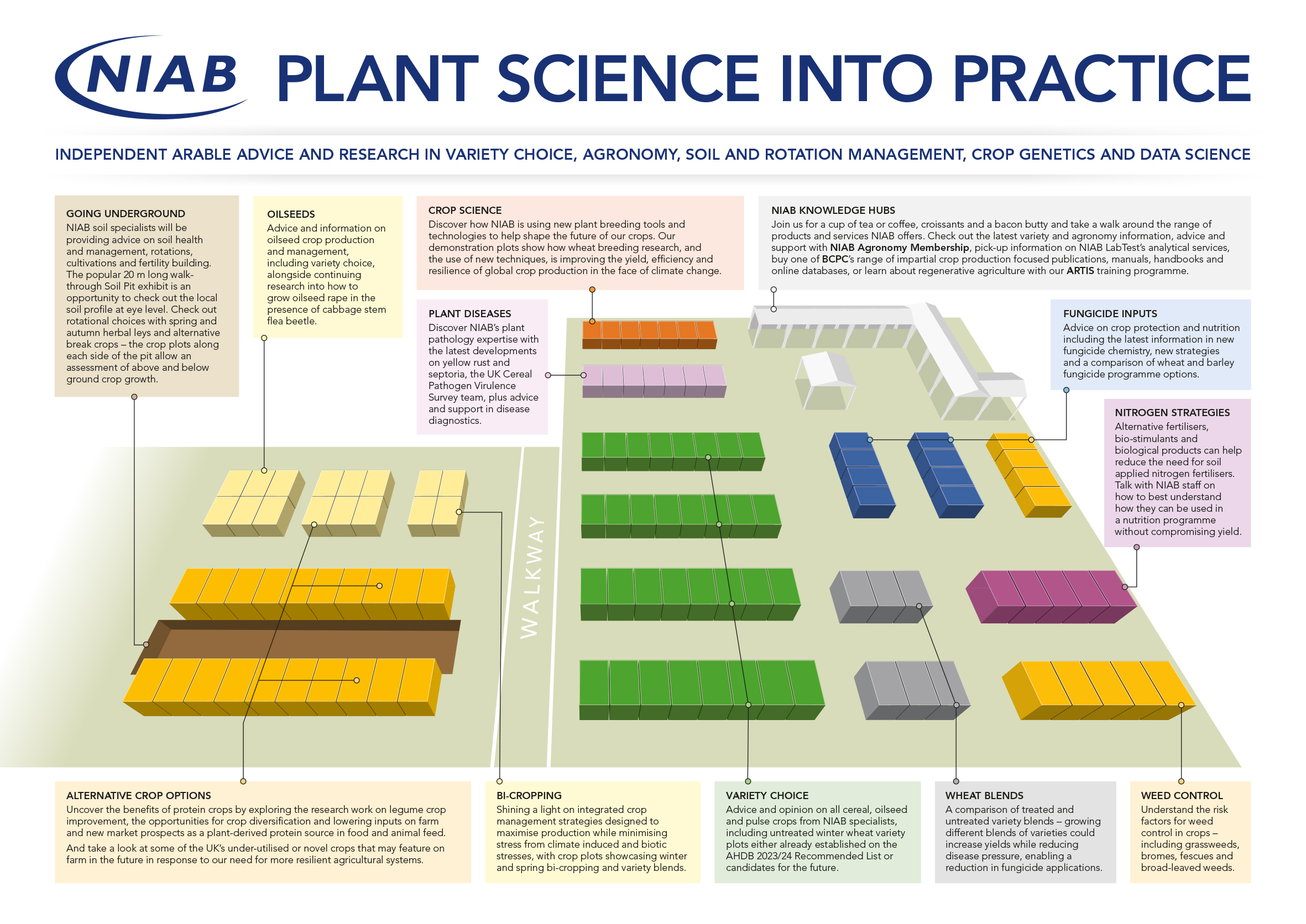
The NIAB stand (no 405), and its neighbouring Soil Hole exhibit (no 406), continues to be the Event’s one-stop shop for the latest independent technical advice and research, with 110 crop and variety plots demonstrating variety choice, agronomy, soil and rotation management and crop genetics.
The traditional winter wheat variety demonstration plots remain at the heart of the NIAB stand and the destination point for all Cereals Event visitors planning next season’s cropping. This year there are 32 varieties either already established on the AHDB Recommended List or candidates, with differences in disease susceptibility between the varieties clearly evident on the untreated plots. NIAB’s variety specialists are available to talk and advise on, not only winter wheat, but variety choice options in all cereals, oilseeds and break crops.
Alongside are plots demonstrating fungicide inputs versus yield in winter wheat and winter barley, a return of the treated and untreated wheat variety blends and a new bi-cropping exhibit. “With new fungicides on the horizon for winter wheat and winter barley, the NIAB plots will compare new cereal fungicides and showcase fungicide inputs versus yield for a range of varieties. “The stand will also shine a light on integrated crop management strategies designed to maximise production while minimising stress from climate induced and biotic stresses, with crop plots showcasing winter and spring bi-cropping and variety blends,’’ says Mr Knight.
The agronomy plots also take a look at alternative nitrogen strategies in cereal crops. Several alternative fertilisers, bio-stimulants and biological products that can help reduce the need for soil applied nitrogen fertilisers are demonstrated. “NIAB is currently trialling some of the innovative products to understand how best they can be used in a nutrition programme without compromising yield. Reducing reliance on nitrogen fertiliser can help to reduce greenhouse gas and ammonia emissions. Our NIAB staff will discuss some of these products and trial plots at the Cereals Event,” finishes Mr Knight.
Summary
The NIAB stand at the Cereals Event is known for providing the latest technical advice and research in variety choice, independent agronomy, soil and rotation management, crop genetics and data science. The full list of exhibits planned for 2023 includes:
- variety demonstration plots - providing expert advice on winter wheat variety choice for 2023/24 with 32 established and new candidate varieties.
- advice on crop protection and nutrition including the latest information in new fungicide chemistry, new strategies and a comparison of wheat fungicide programme options and a demonstration of wheat variety blends;
- research and information on rotations, cultivations, tillage and soil management from NIAB specialists, including a look at alternative break crops to winter oilseed rape and a range of spring crops;
- some of the UK’s under-utilised or novel crops that may feature on farm in the future in response to our need for a more resilient agricultural system, e.g. herbal grazing ley mixtures alongside buckwheat, quinoa, grain maize, durum wheat, hybrid rye and triticale;
- uncovering the benefits of protein crops, including lupins, peas, beans, lentils, chickpeas and soya;
- understanding the risk factors for weed control in arable cropping – including bromes, fescues and broad-leaved weeds such as bur chervil and poppy;
- plant disease research and new diagnostic techniques;
- NIAB crop research; using new plant breeding tools and technologies to help shape the future of our crops. The demonstration plots show how wheat breeding research, and the use of new techniques, is improving the yield, efficiency and resilience of global crop production;
- discovering the science and skills behind NIAB’s unique and long-established plant phenotyping and seed certification services, testing over 1,000 new varieties every year;
- NIAB Agronomy Membership services including the latest crop production advice and farmer-led research, field days, agronomy trials results, unique regional variety information and weekly agronomy updates through the season.
Meet the products and services offered by NIAB in our knowledge hubs including:
- BCPC’s range of impartial crop production focused publications, manuals, handbooks and online databases;
- NIAB LabTest’s analytical services;
- our extensive and successful independent field and glasshouse trialling services.
Contact
Niab
Park Farm Campus
Villa Road
Histon
Cambridge
CB24 9AT, UK
Tel: +44(0)1223 342200
Email: [email protected]


Niab Agronomy
Membership

© NIAB 2026