
Rosy leaf curling aphid (Dysaphis devecta (Walker))
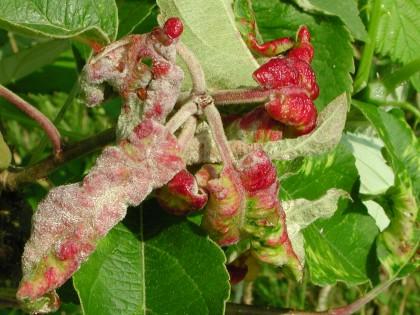
Rosy leaf curling aphid is a widely distributed but localised minor pest of apple.
Infestations occur on the same trees (often older trees with rough bark) year after year and spread from tree to tree is slow. The life cycle involves overwintering on the tree as eggs.
Some apple varieties, including Cox, Ashmead’s Kernal, Fiesta, Fortune, Gala, James Grieve, Kidd’s Orange Red, Lord Lambourne, Merton Worcester, Sunset, Suntan and Winston are resistant to rosy leaf curling aphid. Others, notably Elstar, Falstaff, Idared, Golden Delicious and Worcester Pearmain, are highly susceptible. Bramley is moderately susceptible.
The aphid hatches in April at early green cluster from overwintered eggs on the bark and infests the rosette leaves which then curl and develop the characteristic red colour.
The severity of infestation by rosy leaf curling aphid should be determined in each orchard when pre-blossom pest assessments are done at green cluster. At least 25 trees should be inspected for presence/absence of the pest, concentrating on localities where the pest was seen the previous year.
It is hard to distinguish between the rosy leaf curling aphid and the rosy apple aphid but the latter does not cause the characteristic bright red coloration of leaves caused by the rosy leaf curling aphid.
A localised application of an approved insecticide to control the pest should be considered where the pest is detected.
- If only rosy leaf curling, rosy apple or apple grass aphid are to be controlled, then flonicamid (Mainman) is likely to be a good choice as it is a selective aphicide.
- A full approval for spirotetramat (Batavia) on apples for the control of sucking insect pests will control rosy leaf curling aphid, but growers may prefer to reserve its use for more difficult to control pests such as woolly aphid or rosy apple aphid. It must be applied after flowering and works best when pests are moving from brown wood to green tissue. It will prevent population build-up but does not offer pest ‘knockdown’.
- The EAMU for Flipper (fatty acids) has increased the available options should growers wish to reserve other insecticides for control of pests later in the season. It is known to complement the use of Batavia as it provides quick ‘knockdown’.
- Earwigs are important natural enemies.
Note that these materials are largely ineffective against winter and tortrix moth caterpillars.
- The synthetic pyrethroid insecticide deltamethrin (Decis Forte etc) is also approved for control of aphids on apple but its use should be avoided as it is harmful to predatory mites and other insects.
It is important to apply the above insecticides in warm weather conditions at the full recommended dose and in a sufficient spray volume to give adequate cover.
It is also important to apply the insecticide early, before large colonies form which are difficult to control once surrounded by distorted mature leaves.
Insecticides approved for control of aphids on apple
| Choice of insecticides – efficacy factors | |||||
|---|---|---|---|---|---|
| Active ingredient | Trade name (examples) | Class | Selectivity | Approved for control of | Safety to Typhs |
| deltamethrin | Decis Forte etc. | pyrethroid | broad spectrum | Aphids, codling & tortrix moths | harmful |
| fatty acids | Flipper (EAMU 3419/19) | bioinsecticide | broad spectrum | Aphids, blossom weevil, two-spotted spider mite | unspecified but generally safe in IPDM programmes |
| flonicamid | Teppeki, Mainman | chlordotonal organ modulator | selective | Aphids and woolly aphid | safe |
| maltodextrin | Eradicoat Max (EAMU 1835/22) | polysaccharide | broad spectrum | Aphids, spider mites | harmful |
| spirotetramat | Batavia | tetramic acid derivative | selective | Sucking insect pests | unclassified |
| Choice of insecticides – Safety factors | |||||||
|---|---|---|---|---|---|---|---|
| Hazards | Harvest interval (days) | Max. no. sprays | Buffer zone width (m) | ||||
| Anticholin-Esterase? | Humans | Fish & aquatic life | Bees | ||||
| deltamethrin | no | h, i | ed | d | 0 | u | 18 |
| fatty acids | no | h, i | h | u | 0 | 8 | 20 |
| flonicamid | no | u | h | u | 21 | 3 | sm |
| maltodextrin | no | i | d | d | 0 | 20 | sm |
| spirotetramat | no | h, i | y | d | Start of ripening | 2 | 10 |
| h=harmful, i=irritant, d=dangerous, ed=extremely dangerous, t=toxic, c=closed cab required for air assisted sprayers, sm=statutory minimum of 5 m for broadcast airassisted sprayers u=uncategorised/unclassified/unspecified | |||||||
Control in organic orchards
In organic orchards the pest should be tolerated except where significant damage is being caused especially to young trees. Thus rosy leaf curling aphid is often ignored or tolerated in organic orchards because of the localised nature of the damage it causes. However, it can become important on some varieties in certain years.
- Cultural methods of control mainly rely on natural enemies, which should be encouraged by providing artificial refuges and flowering plants in and around the orchard.
- Early season sprays of fatty acids is the preferred treatment of organic apple growers in the UK for aphids including rosy leaf curling aphid.
- The sprays have to be applied early at the green cluster growth stage (after the overwintered eggs have hatched in spring but before reproduction occurs is best) and in high volumes so that the aphids are thoroughly wetted by the spray.
- Application is sometimes made during gentle rain.
Further reading
Rosy leaf curling aphid - additional information
Contact
Niab
Park Farm Campus
Villa Road
Histon
Cambridge
CB24 9AT, UK
Tel: +44(0)1223 342200
Email: [email protected]


Niab Agronomy
Membership

© NIAB 2026