
Summer fruit tortrix moth (Adoxophyes orana Fischer von Röslerstamm)
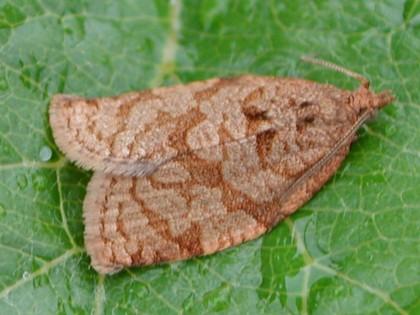
The summer fruit tortrix moth is an important secondary pest of apples and pears, especially in eastern and south-eastern England. The life cycle involves two generations a year in the UK.
Short stalked varieties such as Bramley and Discovery are most susceptible, but all varieties of apple and pear may be attacked.
Damage to foliage is unimportant but damage to fruits occurs at three different times during fruit development.
Larvae of several leaf-rolling tortrix moths are very similar and are difficult to distinguish from each other. The pest should be monitored with pheromone traps weekly from petal fall of apple to the end of August.
The need to treat for the pest should be determined by high trap catches (>30 moths per trap per week) or damage the previous season, or by the presence of high populations of caterpillars in blossom trusses in spring before bloom.
Control
Various insecticides that are approved for control of colding moth, totrix moths or for general caterpillar control are likely to control summer fruit tortrix moth.
- The pest may be controlled with spinosad (Tracer) or with Bacillus thuringiensis (Dipel DF, Lepinox Plus), applied to coincide with egg hatch usually in June.
- Bacillus thuringiensis is considered to be of only moderate efficacy. The first spray should be applied at the onset of egg hatch of the first generation. Further sprays should be applied at 7-10 day intervals until the egg hatch period has ended.
- Synthetic pyrethroids are highly effective but their use should be avoided as they are harmful to predatory mites and other beneficial insects.
- Chlorantraniliprole (Coragen) is also thought to offer incidental control when applied against codling moth.
- Pyriproxyfen (Harpun) may also offer incidental control of summer fruit tortrix moth when applied for codling moth control. It inhibits egg hatch, metamorphosis of nymphs to adults and reduces the fecundity of adult females. However, as a new product to the UK in 2020, further experience is required to inform growers and agronomists of its efficacy at controlling summer fruit tortrix.
- The summer fruit tortrix ganulovirus (Capex) is another option. Highly specific to summer fruit tortrix, it is ideal for use in organic and IPM production systems and has no harvest interval or buffer zone requirement.
- The onset of egg laying is taken as the date when the pheromone trap catch exceeds 5 moths/trap/week. If traps are only examined weekly, the date when this occurred can often be pin-pointed more accurately by examination of daily temperature records.
- The moths fly when dusk temperatures exceed 15°C. The onset of the egg hatching period occurs 7-21 days later, depending on temperature. It can be accurately forecast from daily maximum and minimum air temperatures using the look-up table provided.
- The daily percentage egg development amounts are summed from the date of the onset of egg laying. When the sum reaches 90%, egg hatch is imminent and the first spray should be applied.
- A second generation occurs in August and September which can be damaging on later harvested varieties. The second generation may be controlled in the same way.
Insecticides approved on apple for control of codling, tortrix moths or caterpillars on apple which are likely to control summer fruit tortrix moth or offer incidental control when applied to control other pests
| Choice of insecticides – efficacy factors | ||||||
|---|---|---|---|---|---|---|
| Active ingredient | Trade name (examples) | Class1 | Selectivity | Label rec’s2 | Safety to Typhs | Suggested interval between sprays (days) |
| adoxophyes orana granulovirus | Capex | microbial biocontrol | highly selective | sft | safe | u |
| Bacillus thuringiensis var. kurstaki | Dipel DF, Lepinox Plus | bacterialinsecticide | selective to caterpillars | c | safe | 7 |
| chlorantraniliprole | Coragen (EAMU 0303/22 | anthranilic diamide | selective | c | safe | none stipulated |
| deltamethrin | Decis Forte etc. | pyrethroid | broad spectrum | cm, t | harmful | none stipulated |
| pyriproxyfen | Harpun | metamorphosis inhibitor | selective | cm | safe | none stipulated |
| spinosad | Tracer | neural blocker | selective | C, cm, ftt, sft | safe | u |
| Choice of insecticides – Safety factor Read and and follow the label before applying any sprays |
|||||||
|---|---|---|---|---|---|---|---|
| Hazards2 | Harvest interval (days) | Max. no. sprays | Buffer zone width (m) | ||||
| Anticholin-esterase? | Humans | Fish & aquatic life | Bees | ||||
| adoxophyes orana granulovirus | no | u | u | u | 0 | u | 0 |
| Bacillus thuringiensis | no | u | u | u | Varies with product | Varies with product | 5 |
| chlorantraniliprole | no | h | ed | h | 14 | 1 | 30 |
| deltamethrin | no | h, i | ed | d | 7 | u | 50 |
| pyriproxyfen | no | d | t | u | fruit diameter up to 40mm | 2 | 20 |
| spinosad | no | u | ed | h | 7 | 4 | 40 |
| Keys: 1CSI=chitin synthesis inhibitor, JHA=juvenile hormone analogue 2c=caterpillars, cm=codling moth, ftt=fruit tree tortrix, sft=summer fruit tortrix, t=tortrix, wm=winter moth 3d=dangerous, ed=extremely dangerous, h=harmful, i=irritant, t=toxic, u=no hazard specified |
|||||||
Control in organic orchards
Summer fruit tortrix moth should be less problematic in organic orchards because populations are regulated by natural enemies, especially parasitic wasps and probably also because tree vigour is lower in organic orchards (see ‘Cultural control’).
- If control measures are necessary, sprays of Bacillus thuringiensis or spinosad (Tracer), should be applied in the same way as in conventional orchards (see above).
- In addition, the granulovirus (Capex) that is available to control summer fruit tortrix is highly specific to this pest. It is ingested by larval feeding. The larvae subsequently die and break down. Capex is ideal for use in organic and IPM systems of production. Approval should always be sought from organic certification bodies before use in organic production systems.
Further reading
Summer fruit tortrix moth - additional information
Contact
Niab
Park Farm Campus
Villa Road
Histon
Cambridge
CB24 9AT, UK
Tel: +44(0)1223 342200
Email: [email protected]


Niab Agronomy
Membership

© NIAB 2026