
Fruit tree tortrix moth (Archips podana (Scolopi))
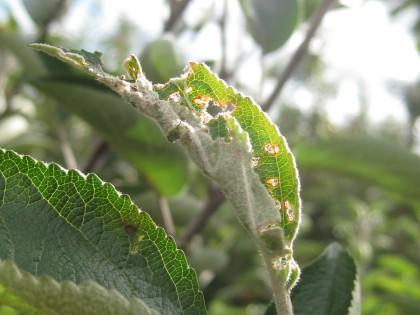
Fruit tree tortrix moth is a moderately important pest of apples and pears in the UK.
The life cycle is simple with the pest overwintering as a second or third instar larva which emerges in spring after bud burst and feeds on the trusses. Pupation occurs after blossom and first generation adults fly in June and early July.
Eggs are laid in batches on foliage and hatch after 2-3 weeks. Adults are readily recognised but larvae may be confused with other caterpillar species.
Larvae feed in leaf rolls and on the surface of fruits making the characteristic damage of small holes in the flesh. Later in the season, near to harvest, larvae make larger surface excavations in the flesh of fruits. There is a partial second generation in August and September.
The pest should be monitored with pheromone traps weekly from petal fall of apple to the end of August. The economic threshold for treatment is >30 moths per trap per week.
Control
Several insecticides are approved for control of tortrix moth and/or other caterpillars on apple and/or pear in the UK.
- The pest may be controlled with a spray of Bacillus thuringiensis (Dipel DF) or spinosad (Tracer), applied to coincide with egg hatch usually in late June or July about 2 weeks after the threshold pheromone trap catch is exceeded.
- Synthetic pyrethroids are highly effective but their use should be avoided as they are harmful to predatory mites and other beneficial insects.
- Spinosad (Tracer) will also control codling moth.
- Codling moth flies slightly earlier than fruit tree tortrix moth but sprays of these insecticides applied for codling moth usually also give good control of fruit tree tortrix moth.
- Chlorantraniliprole (Coragen) is also thought to offer incidental control when applied against codling moth.
- Pyriproxyfen (Harpun) may also offer incidental control of fruit tree tortrix moth when applied for codling moth control. It inhibits egg hatch, metamorphosis of nymphs to adults and reduces the fecundity of adult females. However, as a new product to the UK in 2020, further experience is required to inform growers and agronomists of its efficacy at controlling fruit tree tortrix moth.
Insecticides approved for use on apple which are recommended to control fruit tree tortrix moth or offer some incidental control when applied to control other pests
| Choice of insecticides – efficacy factors | ||||||
|---|---|---|---|---|---|---|
| Active ingredient | Trade name (examples) | Class1 | Selectivity | Label rec’s2 | Safety to Typhs | Suggested interval between sprays (days) |
| Bacillus thuringiensis var. kurstaki | Dipel DF, Lepinox Plus | bacterial insecticide | selective to caterpillars | c | safe | 7 |
| chlorantraniliprole | Coragen (EAMU 0303/22) | anthranilic diamide | selective | c | safe | none stipulated |
| deltamethrin | Decis Forte etc | pyrethroid | broad spectrum | cm, t | harmful | none stipulated |
| pyriproxyfen | Harpun | metamorphosis inhibitor | selective | cm | safe | none stipulated |
| spinosad | Tracer | neural blocker | selective | c, cm, ftt,sft | safe | u |
| Choice of insecticides – Safety factor Read and and follow the label before applying any sprays |
|||||||
|---|---|---|---|---|---|---|---|
| Hazards2 | Harvest interval (days) | Max. no. sprays | Buffer zone width (m) | ||||
| Anticholin-esterase? | Humans | Fish & aquatic life | Bees | ||||
| Bacillus thuringiensis | no | u | u | u | Varies with product | Varies with product | 5 |
| chlorantraniliprole | no | h | ed | h | 14 | 1 | 30 |
| deltamethrin | no | h, i | ed | d | 7 | u | 50 |
| pyriproxyfen | no | d | t | u | fruit diameter up to 40mm | 2 | 20 |
| spinosad | no | u | ed | h | 7 | 4 | 40 |
| Keys: 1CSI=chitin synthesis inhibitor, JHA=juvenile hormone analogue 2c=caterpillars, ftt=fruit tree tortrix, sft=summer fruit tortrix, t=tortrix, wm=winter moth 3d=dangerous, ed=extremely dangerous, h=harmful, i=irritant, t=toxic, u=no hazard specified | |||||||
Control in organic orchards
Fruit tree tortrix moth often causes significant fruit damage in organic orchards.
- If control measures are necessary, sprays of Bacillus thuringiensis (Dipel DF) or, if it is permitted in organic production, spinosad (Tracer) should be applied in the same way as in conventional orchards (see ‘Biological and chemical control’ ).
Further reading
Fruit tree tortrix moth - additional information
Contact
Niab
Park Farm Campus
Villa Road
Histon
Cambridge
CB24 9AT, UK
Tel: +44(0)1223 342200
Email: [email protected]


Niab Agronomy
Membership

© NIAB 2026