
Apple Sawfly (hoplocampa testudinea (Klug))
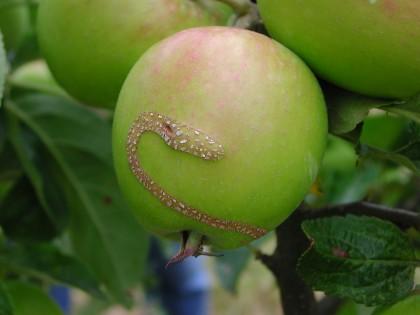
Apple sawfly is a common and important pest of apple. It does not attack pear.
Certain desert varieties, notably Discovery and Worcester, are highly susceptible.
The life cycle is simple. Adults fly during blossom and lay their eggs singly in the side of receptacles leaving characteristic scar marks. Larvae hatch out shortly after petal fall. The larvae burrow beneath the surface of the fruitlets causing characteristic ribbon scars.
More mature larvae migrate from fruitlet to fruitlet burrowing into the core and making large holes contaminated with brown wet frass. These fruits fall from the tree but those more superficially damaged (with ribbon scars) remain on the tree until harvest.
As a minimum, levels of damage must be recorded at harvest and during grading. If damage is seen one year, then insecticide treatment should be applied the next year.
As a further aid to pest monitoring, white sticky traps can be deployed in the orchard before and during blossom to catch adults. Non-UV reflective white gives the best results.
Treatment thresholds have not been determined but, if the blossom is sparse, spraying would probably be justified if more than one or two adults are caught per trap over the blossom period. Note that insecticide treatment is normally applied shortly after petal fall. Note also that the traps themselves are not sufficiently effective to control the pest by mass trapping.
Chemical control
- An appropriate product should be applied at or shortly after petal fall.
- Thiacloprid (Calypso) which was previously approved for use on apples offered incidental control, but its approval was revoked in 2020.
- Synthetic pyrethoid insecticides such as deltamethrin may also give some control of apple sawfly but are not compatible with the IPM programmes employed by most growers because they are harmful to predatory mites and many other natural enemies.
- Growers should take advice from BASIS qualified agronomists before choosing a spray control product for apple sawfly.
Insecticides and fungicides approved for use on apple which are recommended by the manufacturer or which are likely to be effective or partially effective for control of apple sawfly when applied to control other pests
| Choice of insecticides – efficacy factors | |||||
|---|---|---|---|---|---|
| Active ingredient | Trade name (examples) | Class | Selectivity | Approved for control of | Safety to Typhs |
| deltamethrin | Decis Forte etc. | pyrethroid | broad spectrum | Aphids, codling & tortrix moths, apple sucker, capsids, sawflies | harmful |
| Choice of insecticides – Safety factors Read and follow label before applying any sprays |
|||||||
|---|---|---|---|---|---|---|---|
| Hazards | Harvest interval (days) | Max. no. sprays | Buffer zone width (m) | ||||
| Anticholin-esterase? | Humans | Fish & aquatic life | Bees | ||||
| deltamethrin | no | h, i | ed | d | 7 | u | 50 |
| h=harmful, i=irritant, d=dangerous, ed=extremely dangerous, c=closed cab required for air assisted sprayers, t=toxic, u=uncategorised/unclassified/unspecified | |||||||
Control in organic orchards
Sawfly can be a very damaging pest in organic orchards. It is unfortunate that the disease resistant varieties Discovery and Worcester Pearmain favoured for organic apple production are very highly susceptible to sawfly.
- Priority should be given to cultural and biological control methods and fostering the parasitoids Lathrolestes ensator and Aptesis nigrocincta.
- In other countries where its use is permitted or approved, organic growers use extract of the plant Quassia amara to control apple sawfly.
- Sprays are applied at petal fall and the treatment is moderately effective.
Further reading
Apple Sawfly - additional information
Contact
Niab
Park Farm Campus
Villa Road
Histon
Cambridge
CB24 9AT, UK
Tel: +44(0)1223 342200
Email: [email protected]


Niab Agronomy
Membership

© NIAB 2026