
Rosy apple aphid (Dysaphis plantaginea (Passerini))
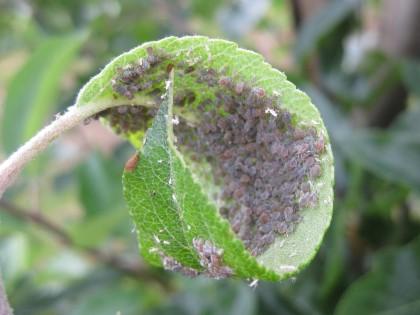
Rosy apple aphid, also known as ‘blue bug’, is one of the most important and damaging pests of apple. A similar species, the pear bedstraw aphid, attacks pear. The life cycle involves migration between the two hosts apple and plantain.
All commercially-grown apple varieties are susceptible, but Bramley, Discovery, Egremont Russet, Golden Delicious and Jonagold are highly susceptible.
Apple orchards should be carefully inspected for the pest and its characteristic damage symptoms (discoloured/distorted/curled outer rosette leaves at the green cluster to pink bud growth stage and again at the end of blossom and during early fruitlet development. The pest can readily be distinguished from the less common rosy leaf curling aphid which causes striking red leaf curling.
Cultural controls such as encouraging natural enemies are useful. Providing refuges and flowering plants in and around the orchard, tolerating less damaging aphid species such as apple grass aphid and avoiding the use of broad-spectrum insecticides will help foster natural enemy populations in the summer and autumn so reducing populations in the current and following seasons.
Control
A spray of an approved aphicide should be applied as soon as infestation is detected.
- If only rosy apple aphid is to be controlled, then flonicamid (Mainman) is likely to be a good choice as it is a selective aphicide.
- A full approval for spirotetramat (Batavia) on apples for the control of sucking insect pests will control rosy apple aphid. It must be applied after flowering and works best when pests are moving from brown wood to green tissue. It will prevent population build-up but does not offer pest ‘knockdown’.
- The EAMU for Flipper (fatty acids) has increased the available options should growers wish to reserve other insecticides for control of pests later in the season. It is known to complement the use of Batavia as it provides quick ‘knockdown’.
Note that these materials are largely ineffective against winter and tortrix moth caterpillars.
- The synthetic pyrethroid insecticide deltamethrin (Decis Forte etc) is also approved for control of aphids on apple but its use should be avoided as it is harmful to predatory mites and other insects.
It is important to apply the above insecticides in warm weather conditions at the full recommended dose and in a sufficient spray volume to give adequate cover.
It is also important to apply the insecticide early, before large colonies form which are difficult to control once surrounded by distorted mature leaves.
Rosy apple aphid has developed strains resistant to aphicides in central and southern European countries but resistance has not been demonstrated in the UK.
- The risks of the development of resistance to insecticides should be reduced by only treating when necessary and varying the insecticides used for control.
Insecticides approved for control of aphids on apple
| Choice of insecticides - efficacy factors | |||||
|---|---|---|---|---|---|
| Active ingredient | Trade name (examples) | Class | Selectivity | Approved for the control of | Safety of Typhs |
| deltamethrin | Decis Forte etc. | pyrethroid | broad spectrum | Aphids, apple sucker, capsids, codling & tortrix moths, sawfly | harmful |
| fatty acids | Flipper (EAMU 3419/19) | bioinsecticide | broad spectrum | Aphids, leafhoppers, mealy bugs, spider mites | unspecified but generally safe in IPDM programmes |
| flonicamid | Mainman | chlordotonal organ modulator | selective | Aphids and woolly aphid | safe |
| maltodextrin | Eradicoat Max (EAMU 1835/22) | polysaccharide | broad spectrum | Aphids, spider mite | harmful |
| spirotetramat | Batavia | tetramic acid derivative | selective | Sucking insect pests | unclassified |
| Choice of insecticides - safety factors | |||||||
|---|---|---|---|---|---|---|---|
| Hazzards | Harvest interval (days) | Max. no. sprays | Buffer zone width (m) | ||||
| Anticholin-Esterase? | Humans | Fish &aquatic life | Bees | ||||
| deltamethrin | no | h, i | ed | d | 7 | u | 50 |
| fatty acids | no | h, i | h | u | 0 | 8 | 20 |
| flonicamid | no | u | h | u | 12 | 3 | sm |
| maltodextrin | no | i | d | d | 0 | 20 | sm |
| spirotetramat | no | h, i | t | d | Start of ripening | 2 | 10 |
| h=harmful, i=irritant, d=dangerous, ed=extremely dangerous, t=toxic, c=closed cab required for air assisted sprayers, sm=statutory minimum of 5 m for broadcast airassisted sprayers u=uncategorised/unclassified/unspecified | |||||||
Control in organic orchards
Cultural controls such as encouraging natural enemies are useful but, in addition, early season sprays of fatty acids is the preferred spray treatment of organic apple growers in the UK for aphids including rosy apple aphid.
- The sprays have to be applied early at the green cluster growth stage (after the overwintered eggs have hatched in spring, but before reproduction occurs is best) and in high volumes so that the aphids are thoroughly wetted by the spray.
- Application is sometimes made during gentle rain.
- Control is especially important on young trees which can be very severely damaged in the years of establishment.
- In other European countries, an oil extracted from the neem tree is used for control of rosy apple aphid in organic orchards but it is not registered for use in the UK. It is fairly effective but precise timing of application shortly after hatching of eggs in spring is critical.
Further reading
Rosy apple aphid - additional information
Contact
Niab
Park Farm Campus
Villa Road
Histon
Cambridge
CB24 9AT, UK
Tel: +44(0)1223 342200
Email: [email protected]


Niab Agronomy
Membership

© NIAB 2026