
Apple Rust Mite (Aculus schlechtentali (Nalepa))
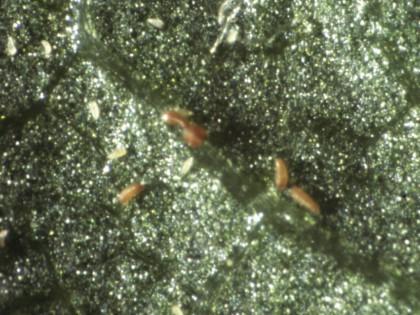
Apple rust mite is an important secondary pest of apple. A similar species, the pear rust mite, is an important and frequently damaging pest of pear.
Apple rust mite is seldom a problem in orchards where the orchard predatory mite, Typhlodromus pyri, is established. The predatory mite should be introduced, by transferring summer prunings in summer to newly planted orchards and to orchards where it is absent.
Pesticides harmful to the orchard predatory mite should not be used except as a last resort, as they cause outbreaks of rust and spider mites.
Rust mites are minute but can be seen with a x20 hand lens and are then readily recognised. They have a simple life cycle, overwintering behind buds in the previous season’s extension growth. Monitoring the number overwintering behind buds in the previous season’s extension growth is important in orchards where a satisfactory and stable balance between the mite and the orchard predatory mite has not been established.
They invade rosette leaves at bud burst and green cluster, causing shrivelling and puckering damage to the outer rosette leaves if present in high numbers.
They colonise the outer surface of the receptacle during flowering and the surface of young fruitlets round the calyx during early fruitlet development. This damage is most important and occurs at low to moderate population densities (1 mite per flower or young fruitlet).
Feeding on developing fruitlets causes russeting round the calyx and on the cheek of the fruit.
Feeding on the undersides of leaves in summer causes browning.
Chemical control
- A programme of sulphur sprays (Microthiol Special) at reduced rate (3-5 kg a.i. / ha), applied to control mildew on apple, will suppress rust mite and fruit tree red spider mite. Some apple varieties are sulphur shy (consult the label for details) but are often safe at low rates. However, multiple sprays of sulphur are likely to be harmful to orchard predatory mites, so such an approach is not ideal.
- Clofentezine (Apollo) and tebufenpyrad (Shirudo - Expries April 2026) are approved for control of fruit tree red spider mite on apple but are not specifically recommended for control of apple rust mite. When applied for control of fruit tree red spider mite, they may give partial control of rust mite but should not be relied on to control damaging infestations.
- The acaricides acequinocyl (Kanemite) and hexythiazox (Nissorun) are recommended for the control of fruit tree red spider mite. Trials conducted by the manufacturer of these products showed erratic results against rust mite. As they have a contact mode of action only, they must contact the mites to be effective. They might offer incidental control of rust mite when applied for fruit tree red spider mite control. Hexythiazox (Nissorun) works only on the eggs and early motile stages of fruit tree red spider mite and is ineffective against the adults, so application timing is critical.
- A full approval for spirotetramat (Batavia) on apples for the control of sucking insect pests will help to suppress apple rust mite. It must be applied after flowering and works best when pests are moving from brown wood to green tissue. It will prevent population build-up but does not offer pest ‘knockdown’.
- The bioinsecticide fatty acids (Flipper) has an EAMU approval for use on apples (3419/19). It is effective at controlling sucking insect pests such as aphids, whitefly and mites, so is likely to offer incidental control of apple rust mite when applied for other pests. It is known to complement the use of Batavia as it provides quick ‘knockdown’. Its safety to beneficial insects such as Typhlodromus pyri and the parasitic wasp Platygaster demades is unknown, but it is generally safe to many other predators and parasitoids, so is considered to be more suitable to IPDM programmes than the synthetic pyrethroids.
Insecticides, acaricides and fungicides approved for use on apple which are recommended to control apple rust mite, or will offer some incidental control when applied to control other pests or diseases.
| Choice of insecticides = efficacy factors | |||||
|---|---|---|---|---|---|
| Active ingredient | Trade name (examples) | Class | Selectivity | Recommended for control of | Safety to Typhs |
| acequinocyl | Kanemite | acaricide | selective | Fruit tree red spider mite, two-spotted spider mite and rust mite on apple | safe |
| clofentezine | Apollo | acaricide, ovicidal | selective | Winter eggs of fruit tree red spider mite on apple | safe |
| fatty acids | Flipper (EAMU 3419/19) | bioinsecticide | selective | Aphids, blossom weevil, two-spotted spider mite | unspecified but generally safe in IPDM programmes |
| hexythiazox | Nissorun | acaricide, ovicidal | selective | Two-spotted spider mite | harmful |
| spirotetramat | Batavia | tetramic acid derivative | selective | Sucking insect pests | unclassified |
| sulphur | Microthiol Special (EAMU 3241/25) | fungicide & acaricide | selective | Scab and mildew on apples and pears. Gall mite on black-currants. | inter-mediate |
| tebufenpyrad | Shirudo (Expires April 2026) | acaricide and aphicide | selective | Red spider mite and rust mite | u |
|
* CSI = Chitin synthesis inhibitor *METI = mitochondrial electron transport inhibitor |
|||||
|
Choice of acaricides - Safety factors Read and follow the lable before applying any sprays |
|||||||
|---|---|---|---|---|---|---|---|
| Hazards2 | Harvest interval (days) | Max. no. sprays or doses | Buffer zone width (m) | ||||
| Anticholin-esterase? | Humans | Fish & aquatic life | Bees | ||||
| acequinocyl | no | h, i | t | u | 30 | 1 | 20 |
| clofentezine | no | u | t | u | 35 | 1 | u |
| fatty acids | no | h, i | h | u | 0 | 8 | 20 |
| hexythiazox | no | h, i | t | u | 28 | 1 | 15-30 depending on time of application |
| spirotetramat | no | h, i | t | d | Start of ripening | 2 | 10 |
| sulphur | no | u | u | u | 1 | 2 | u |
| tebufenpyrad* | no | h | ed | d | 7 | 1 | 30 |
| Keys: d=dangerous, ed=extremely dangerous, h=harmful, i=irritant, t=toxic, u=unspecified or unclassified, sm= statutory minimum*CSI=chitin synthesis inhibitor not recommended for use with hand-held sprayers | |||||||
Control in organic orchards
Emphasis should be placed on natural control by the orchard predatory mite Typhlodromus pyri. Application of foliar sprays of fatty acids or pyrethrins (Pyrethrum 5 EC – authorised for use until 2020) which are harmful to the predatory mite, should be avoided unless absolutely necessary.
- Programmes of sprays of sulphur are often applied for scab and mildew control in organic apple orchards and these suppress apple rust mite.
- Sulphur-tolerant strains of the orchard predatory mite develop eventually but the use of sulphur can lead to outbreaks of fruit tree red spider mite.
Apple rust mite - additional information
Further reading
Contact
Niab
Park Farm Campus
Villa Road
Histon
Cambridge
CB24 9AT, UK
Tel: +44(0)1223 342200
Email: [email protected]


Niab Agronomy
Membership

© NIAB 2026