
Niab Landmark: Issue 62 - Autumn 2026
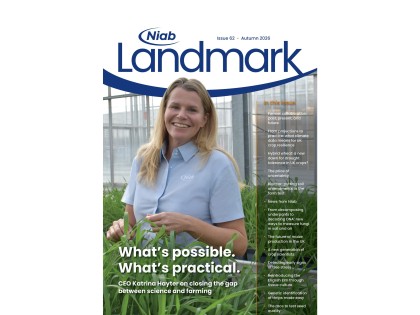
The latest edition of Landmark, Niab's corporate magazine featuring news, research and information from across the organisation, is now available to read and download.
Available to all - access the online flip-book and downloadable PDF versions
Niab Landmark: Issue 62 - Autumn 2026
What’s possible. What’s practical. In the latest issue of Landmark, we look at how science, technology and farmer experience can come together to tackle some of the biggest challenges facing UK agriculture. From climate change and drought-resilient wheat to the future of maize, biochar, soil health and the economics of uncertainty, the issue explores what emerging research could mean for productive, profitable and resilient farming.
It also takes a closer look at technologies and techniques changing how we understand crops and agricultural systems—from sensors that can detect water stress in trees to DNA-based identification of fungi and thrips, rapid seed testing, and tissue culture to help restore disease-resistant English elms. Together, these stories demonstrate Niab’s role in turning scientific innovation into practical knowledge, evidence and solutions that can work on farm.
Articles include:
Meeting the challenge: why Niab matters more than ever
In her first Landmark article as Niab’s Chief Executive, Katrina Hayter sets out why closing the gap between scientific innovation and what happens on farm is more important than ever, as farmers face increasing pressure from markets, input costs, climate, regulation and environmental expectations. She explains how Niab can connect science, genetics, agronomy, testing and farmer knowledge to develop solutions that are not only scientifically credible, but practical, economically relevant and resilient.
Farmer collaboration: past, present and future
With the new £30 million Farmer Collaboration Fund opening in England, Stuart Knight looks at how working together can help farmers test ideas, share knowledge and find practical solutions. He explores what today’s farmer-led collaboration can learn from a long history of farmers working together.
From projections to practice: what climate data means for UK crop resilience
Climate change is already changing the conditions in which UK crops are grown — but what does that mean in practice? The Met Office and crop researchers are working to turn climate projections into useful information for crop choices, breeding and farm management.
The price of uncertainty
It’s not just prices that make farm profitability difficult to predict — increasingly variable yields add another layer of uncertainty. Will Vaughan-France explores how price and yield volatility interact, and what this means for the stability of arable farm profits.
The future of UK maize production
Climate change is opening up new opportunities for maize production in parts of the UK, but increasing drought and weather variability bring new risks. Ellie Roberts examines what the future could hold for UK maize — and why resilient genetics, healthy soils and effective water management will all be critical.
Hybrid wheat: a new dawn for drought tolerance in UK crops
Could hybrid wheat deliver higher yields and greater resilience to drought? Tally Wright explores the science behind the next generation of hybrid wheat — and why independent UK trials will be vital to proving whether the promise translates into performance on farm.
ADOPT – biochar: putting soil amendments to the farm test
Could biochar help farmers make better use of nutrients already in the soil and reduce reliance on artificial fertiliser? Niab's Poppy de Pas is putting the idea to the test on a working farm through an ADOPT project examining both its agronomic potential and the practical challenges of using it at field scale.
From decomposing underpants to decoding DNA
Fungi play complex roles in agriculture, from causing crop disease and fungicide resistance to supporting soil health and nutrient cycling. Nichola Hawkins explains how Niab and its research partners are developing new DNA-based approaches to identify fungi in soil and air, providing a much more detailed picture of fungal communities and helping understand their implications for disease risk, soil health and resistance management.
Genetic identification of thrips made easy
Identifying thrips under a microscope can be slow and requires specialist expertise — yet knowing which species is present can make a big difference to pest management. Francis Wamonje explains how Niab is developing a rapid DNA-based test that could allow growers and agronomists to identify thrips directly from strawberry flowers.
Reintroducing the English Elm through tissue culture
Dutch Elm Disease wiped out an estimated 25 million elms in Britain — but could resistant trees help bring them back? Kirsty McLeary explains how Niab’s tissue culture team is helping turn disease-resistant breeding material into healthy young trees now being planted across the UK.
Detecting early signals of tree stress
What if a tree could tell you it was running short of water before you could see any signs of stress? Graham Dow shows how Niab is testing sensors that continuously monitor electrical signals in apple trees, with the potential to support earlier intervention and more precise, automated irrigation.
The race to test seed quality
When the window for autumn drilling is tight, waiting for traditional seed tests can be costly. Asia Roberts-Yalland explores how tetrazolium testing can assess cereal seed viability and vigour within 24 hours and the fascinating history behind the race to develop rapid seed tests.
Contact
Niab
Park Farm Campus
Villa Road
Histon
Cambridge
CB24 9AT, UK
Tel: +44(0)1223 342200
Email: [email protected]


Niab Agronomy
Membership

© NIAB 2026