
Extreme weather is the new norm
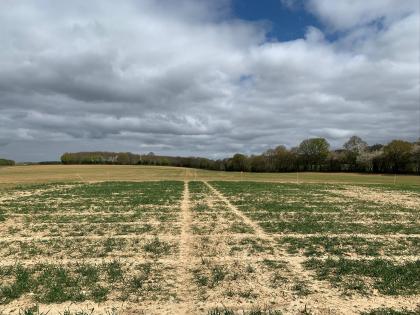
Jim Orson, a special adviser to Niab, writes his latest blog post on the practice of spraying in hot conditions.
I have written well over 200 blogs for the Niab website. Each one has been commented upon by Stuart Knight before publication. I am so grateful for his constructive remarks over the years. He is leaving Niab soon and it is a big hole to fill. Stuart combines a good practical experience with a truly respectful and knowledgeable understanding of the science. I am afraid that particular link in the industry is slowly being eroded and increasingly it is crop management by press notice. I know that this will not happen in Niab and Stuart’s successors will continue to be aware of the wider science as well as how it applies in practice.
Now I have said all that, I need a few hundred words to fill this blog! As it turns out, that is no problem because I have had a few enquiries this summer about the optimum practice for spraying droughted crops and weeds in hot conditions.
On the face of it, it is a fairly simple question, but it involves a host of issues. These include: drought resulting in more leaf wax and sometimes a thicker plant cuticle; the plant hormones that increase in droughted plants can in themselves reduce efficacy of some pesticides; what are the implications of a more rapid evaporation of spray liquid in hot conditions?
After reading many associated scientific studies, and to put it as simply as I can, it seems that in hot and drought conditions the optimum time to spray is when the target plant is as, for the want of a better word, hydrated as possible at the time of application. It also important that the target plant, at least for some herbicides, is metabolically active at and sometimes for a short period after spraying. From an application point of view, it is essential that the spray droplets hang around in liquid form on the target plant surface long enough to ensure good absorption of the pesticide.
There has been little or no UK field research on this issue. Mike May and Graham Hilton did a time-of-day spraying study in sugar beet in the mid-1990s at the Morley Research Centre in Norfolk. The results from an experiment done in the extremely dry spring of 1995 are summarised in the graph below. The herbicide mixture used contained an element of soil residual activity and so in the dry soil conditions may not have been the most effective approach. The legend to the graph is slightly misleading and the solid line indicates the percentage reduction in weed vigour. It is not weed control because the impact of the herbicides used in the experiment on relatively advanced weeds is to stunt rather than to kill.
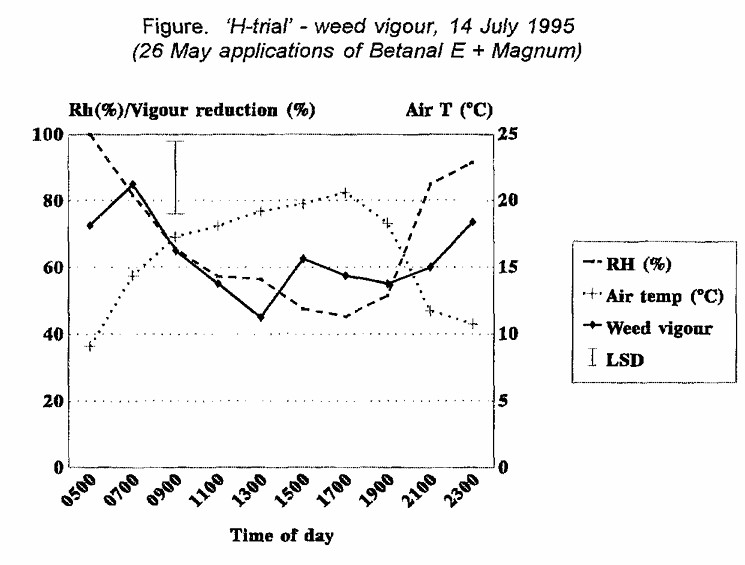
This one example suggests that it is best to spray early in the mornings or, as second best, late in the evening (my sympathy to spray operators) when drought is significantly affecting weed growth. It has to be stressed that 1995 was an exceptionally dry year and it was the previous year to this when our supplier Cambridge Water imposed a hose pipe ban. Significantly, the Met Office warns that we must now be more prepared for extreme weather events as they are the ‘new norm’.
It should also be noted that there was some Danish research carried out in dry conditions that very much favoured early morning and middle of the day applications over evening applications for some cereal herbicides. More research has been done in the USA which, in general, favours morning and particularly midday herbicide applications over evening applications. These USA research papers did not mention to what extent weeds were suffering from drought stress.
So, there is a general lack of convincing evidence as to what time of day to spray very droughted weeds in hot conditions. However, all the studies I have read suggest spraying from around an hour or so after dawn to ensure the weeds (and hopefully the spray operator!) have responded to daylight and become metabolically active. It is wise to stop spraying when the weeds again appear to be suffering after their nightly tonic of higher humidity and lower temperatures. Evening spraying may only be relatively successful for some herbicide modes of action but it is not clear which.
There are other issues which, in pursuit of brevity, I have largely ignored. For instance, some pesticide groups are broken down on the leaf surface by high levels of UV light. This includes the triazole fungicides. Formulation may reduce this process but please read product labels carefully. The only study I have found on the time of day to apply fungicides (Golden Harvest | Best Time of Day for Corn and Soybean Fungicide Applications) favoured morning and evening applications but the advantage over middle of the day applications was not great. Again, it was not clear whether the soya and maize crops were under stress at the time of application.
Finally, what is the preferred spray application technique to adopt in hot and dry conditions? This is discussed by Tom Wolf, the Canadian spray expert. He also outlines the approach recommended in Australia for spraying in hot conditions. This relies on Delta-T, which is a guide to how long spray droplets will survive in liquid form on the leaf surface. However, my estimations of Delta T in the Morley experiment suggest that it was a hopeless guide to the best conditions for spraying. So, Delta T does not provide sufficient information when plants are under stress; a fact that is recognised in the guidelines from the Australian levy organisation GRDC. By the way, Tom Wolf is very much of the opinion that the time of day of spray application has less impact on fungicide efficacy than herbicide efficacy.
We need much more research on spray management under extreme weather conditions. This blog has attempted to summarise the current knowledge but until we know more, there has also got to be some reliance on personal experience.
At this point, I was going to lament the closure of the Silsoe Spray Application Unit. However, this sad news has been tempered by the news that its key staff and specialist facilities have been retained in a new research company Quantispray. I am sure that you will join me in wishing its backers and the staff well. In these troubled times the UK industry needs to retain a core expertise in many areas, including spray application.
Contact
Niab
Park Farm Campus
Villa Road
Histon
Cambridge
CB24 9AT, UK
Tel: +44(0)1223 342200
Email: [email protected]


Niab Agronomy
Membership

© NIAB 2026